Monday, September 30, 2019

2019 Muscat Canelli, recap of days 1 through 10

Here's some recap and thoughts, running from the grape purchase, through crush day, and then to racking the must off the gross lees.

First, even if whoever you talk to at the grape merchant says you don't need to place an order in advance, do it anyway if you know you have someone to do the driving.  Not doing it this year meant we missed out on the Sauv. Blanc grapes that we wanted to work with (though the Muscat C are another wow and another adventure).

Second, because September is nutty busy at the 11th Street homestead and we just don't know very far in advance whether we'll have a Saturday, Sunday, or both for winemaking, we've had a number of years in the last four or five where we brought the grapes down on a Saturday and then worked the wine on a Sunday.  But it's good to know that, at least if we're only making white or only making red, there's plenty of time to set up while the grapes are on their three hour drive down from Hartford, then do the crush day work, clean up, and still have a fine feast for the winemakers.  This year we even finished the setup a little too early and had an hour of downtime before the grapes arrived.

Third, bring the stomping barrels and primary fermenters up from the cellar at least a few days before crush day, even the weekend before.  It seems unavoidable that they come out of the cellar smelling musty.  A week of sunshine and fresh air makes a big, big difference to getting them ready to work with.

Fourth, if we're making whites, use two barrels for stomping instead of the one that we used this year and last.  That way the sorting and destemming crews don't have to wait and twiddle their thumbs while the stompers and press crews do their thing.  At one point this year we must have had at least a half dozen folks just watching the press gang because the operations were all bottlenecked.  Doodle doo.

Fifth, do all the yeast research so that expectations are set.  I might not have sweated completely filling the 100 liter fermenter if I understood how low-foaming QA23 is.

Sixth, just go ahead and purchase new bubblers every year.  It won't break the bank and we won't have to worry whether there's any leftover scuzz in the downspout.

Seventh, either run the big honkin commercial fan in the cellar or consider buying a portable AC unit that can vent out through the back hatch.  It would be pretty far out to see if we could keep the cellar 10 degrees cooler and see how that might affect the fermentation.  Why?  The must tracked the ambient cellar temperature within a one or two degrees farenheit all through the primary.

That's the bulk of it. HUGE THANKS to everyone who had their hands or feet in the grapes this year.  It's hard to express what it means to us to have you all here, working, laying the groundwork for the ridiculous June celebration


And here's a little day 10 update.

In the first 8 hours after the transfer to carboys all of the bubblers fouled at least once, but are now clean and gurgling happily.  Counterintuitively (to me), the small vessel that had the yeasty bottom of the fermenter poured into it and then became a volcano of foam, is now the quietest of the gang.

Here's what CB 3 of 5 looks like. (And I should really get into the habit of loading the video to Youtube or Vimeo so they are better quality, but... lazy!)


Sunday, September 29, 2019

2019 Muscat C., day 9

6:30 AM
Cellar 77 F, outside 71 F, must 79 F
Brix: 0

It's time to move the wine.  Still fizzing, brix readings bouncing around zero.

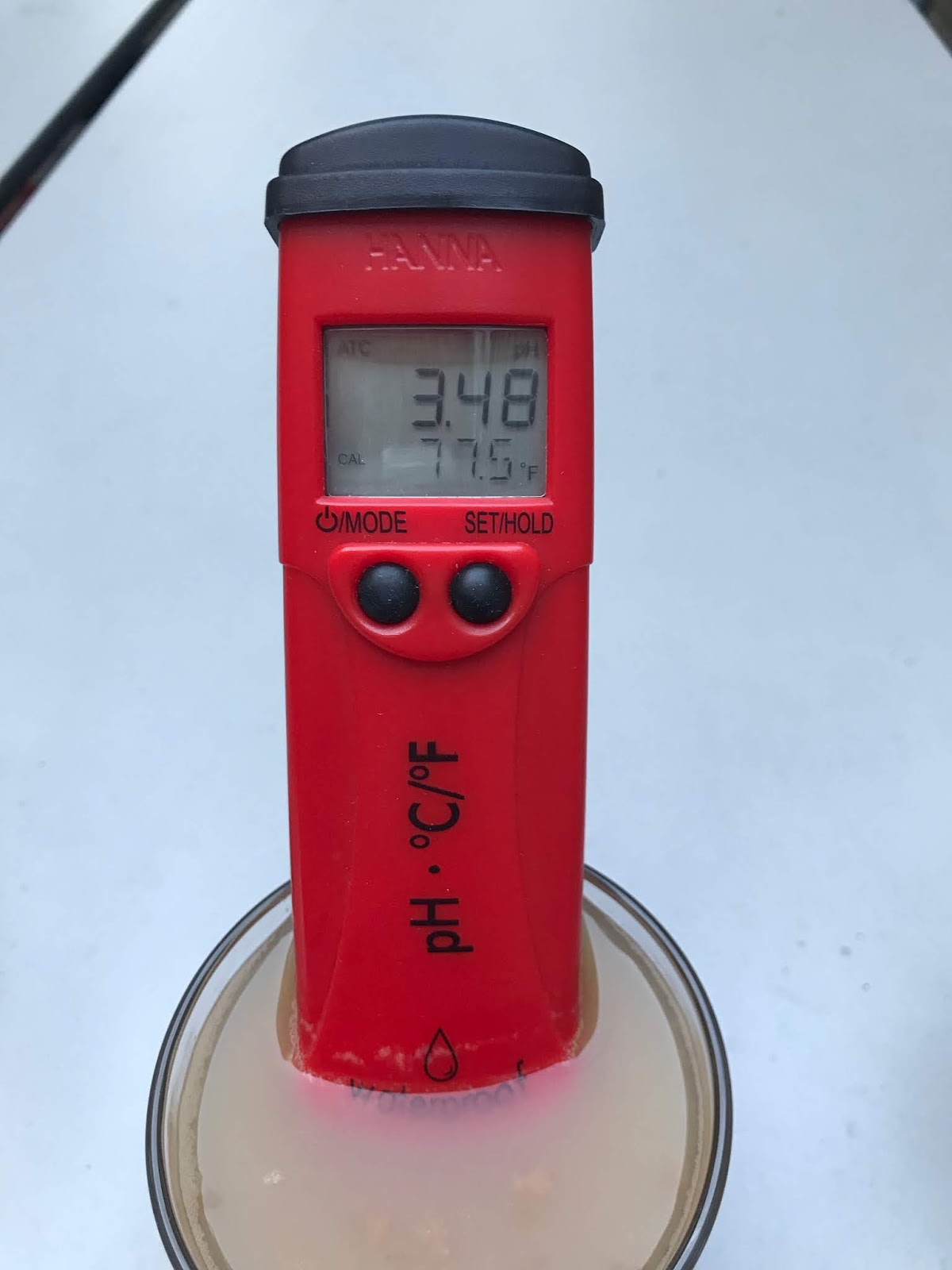
I have not been checking for acid, pH, SO2, and really want to avoid any fiddling.  Still, since I wanted to look at a sample of the must, I took a quickie.  3.48, a tad high and I will test again before moving the wine to carboys.  If I were a really good person I'd also haul out the acid test chems.  (And after hitting 'publish' I tested pH again with more patience: 3.45.)

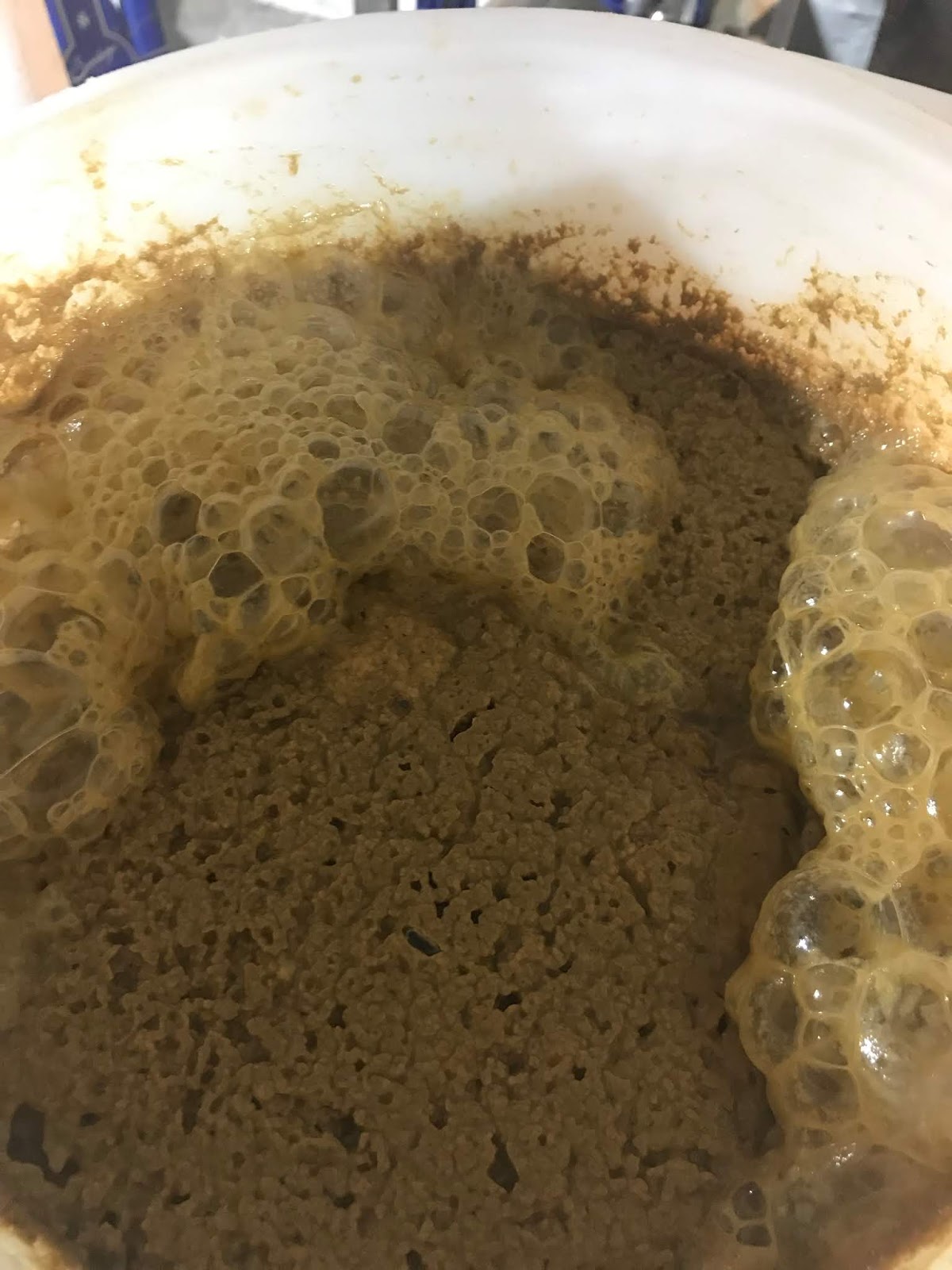
Some pics: the hopeful empties getting themselves ready; a sample of the must after it's been sitting a few minutes and you can get a feel for just how much yeast and solids are in it; the slightly too high  pH reading.
Hopeful empties.

Settling.  Lots of gunk.
A more patient reading gave me 3.45.


11:30 AM
Hoot, mon! 

We've moved from the primary fermenter to 5+5+5+5+3, leaving a fair amount of very yeasty must behind.  The transfers of the firs four carboys were silky smooth. I decided that rather than have a completely mucky fifth 5 gallon I'd go into a three, but that did not stop the three from being insanely lee-filled and nearly volcanic.  Pictures below tell the story.  The three gallon carboy was so out of control I decided to stick a wine thief into the stopper to create an extra long chimney for the gassing off.  when it calms I'll go back to the bubbler. 
Racking off of the gross lees.


Saturday, September 28, 2019

2019 Muscat C., day 8

8:00 AM
Cellar 75.5 F, outside 64 F, must 78 F
Brix: 3.8*

Used the short scale hydrometer directly in the fermenter and readings bobbled around over the course of a minute or two from 3.6 to 3.9 and I'm calling it 3.8.  Today we should move from the fermenter to carboys.  The visible ferment is much as it's been and progressing as it has the last few days - fine fizzy bubbling, no foam.

9:30 PM 
Cellar 77 F, outside 73 F, must 78 F
Brix: 2.6

Well, too much block party, too much playing, too much winding down after a Negroni at home.  Distributing the must into carboys will have to wait until the morning.  All else is steady as she goes.

Friday, September 27, 2019

2019 Muscat C., day 7

7:30 AM 
Cellar 75 F, outside 59 F, must 76
Brix: Probaby 6

The long scale hydrometer is saying that Brix is 5ish and the short scale hydrometer is saying No way, dude, I think you're at least 6. So I've put it into the chart as 6.  Happens every year, this disagreement, at right about this stage.  You'd think I'd try to calibrate the two.

The must is so chunky in the test cylinder, and there's no foam in the fermenter, so that it's become easier to test Brix in the fermenter itself.  I also thought about just straining what I put into the test cylinder.  Maybe this evening.

I haven't said anything about color.  It's still apple juice brown.  It's hard to imagine it becoming the custard yellow and then the final mellow yellow that we've seen in the carboys each year we've made Muscat A.  (And, coinkydink, last night with dinner we drank Zibibbio in Pithos from COS - Zibibbio is the local name for Muscat Alexandria. Alissandria.  It's yellow.)

Rough calculation is that the must is now something like 10% alcohol, using the low end of the sugar to alcohol conversion rate (.55), and heading to 13%.

(The conversion rate can be from .55 to .64. From what I read, you'd need a cooler ferment to get to higher alcohol in white wine - a lot cooler than ours. And QA23 yeast dies at 16% alcohol.  So, assuming we ferment to dryness at high heat and the starting juice was at 24 Brix: 24*.55=13.2% alcohol.  We might have residual sugar lowering the alcohol, or we might have a higher conversion rate raising the alcohol, and we won't know.  We've never had the alcohol level of the wine professionally tested.)

9:00 PM
Cellar 75 F, outside 65 F, must 76
Brix: Probaby 4.5

Fizz continues to get slower and finer.  At this point we can probably just move to carboys, especially given how little foam is being generated - none, really.  On the other hand, there's so little headspace in the fermenter that it feels fine to let it go closer to zero.  Will decide tomorrow.

Not clear how much will be lost to the gross lees, or how much of those lees we'll want to transfer into the last carboy, but we're likely looking at five full 5 gallon carboys with a gallon of lee-chunky juice to toy with.

Thursday, September 26, 2019

2019 Muscat C., day 6


6 AM
Room 75 F, Wine 77 F, Outside 61 F
Brix 10

No bubbler action. Fermentation is fine and fizzy, as it has been for a couple of days, with no foaming.

The Brix measurement is at 10, but the bubbling inside of the measuring cylinder is so strong that after a minute or so the hydrometer is obscured.  This evening I'll try to get a decent photo of what the juice looks like in the cylinder - very chunky seeming.  

At 108 hours we've converted about 58% of the sugar, most of it in the last 72 hours.


8:30 PM
Room 76 F, wine 77 F, Outside 66 F
Brix 8

Fizz is finer and the delta from this morning is much less than last night's delta. Hurry up and wait. Might be in range of the short scale hydrometer tomorrow evening, if not morning.

I mentioned this morning that the juice (now must) is awfully chunky.  Video below.

Wednesday, September 25, 2019

2019 Muscat C., Day 5

6 AM: Cellar: 75, Outside: 59, Wine: 78
Brix: 18*

Why the * for Brix? I measured it in the beaker, and that's what's shown.  I measured it in the tank, where it's fizzing like nuts, and got readings that started at 12 and rose to 15. Fun to see and it would save some cleaning, but probably not a great idea. But either way it's the largest dip in Brix between readings.

Much like last evening, only more so.  Almost all fizz and no foam.

6 PM: Cellar: 756 Outside: 75, Wine: 77
Brix: 15.5

Visually and audibly much the same as this morning.  Brix dropping quickly.

Tuesday, September 24, 2019

2019 Muscat C, day 4

5:45 AM
Cellar: 77 F
Outside: 67 F
Juice: 78 F
Brix: 22 (Oh, for Pete's sake)

Shag much the same, & no bubbler action.  (Let's get some more fermentation going, fellas.)  Last evening and this morning increasing smell of winemaking down there, if not any more measurable evidence.  Pouring the beaker of juice back into the tank, after testing Brix, sets up heavy bubbling reaction, so you know stuff is going on down there. Not having any bubbler action just makes me worry whether 60 hours after pressing the juice is throwing off enough CO2 to protect itself.

9:30 PM
Cellar: 76 F
Outside: 67 F
Juice: 78 F
Brix: 21

Very unexpected change! Foam has broken up into little cheesy pieces, and it's fizzing like hell. Check the video and turn up the volume.

No bubbler action, even with all that fizz, and so I've lessened the amount of water in the bubbler - maybe it was just too big a burp to sustain.  Have strapped icepacks to the outside of the tank again.

Monday, September 23, 2019

2019 Muscat C., day 3

6:30 AM
Cellar: 76 F
Outside: 70 F
Juice: 76 F
Brix: 22

No bubbler action but louder, more active shaggy surface.  Again, juice is at the ambient temperature of the room.  Drop of 2 Brix if I have it right, - about 8% from 24 hours ago.  Forecast for today is to reach 88 F - versus 66 F for a year ago.  Let's try strapping ice packs to the beast.


9:30 PM
Cellar 80
Outside 70
Juice 80
Brix 22

No measured difference in Brix, and no visual difference in foam.  Too warm!  The outside temp has dropped and tomorrow will be a high of 79 with an overnight low 10 degrees lower.   The heat in the cellar is worrisome - 6 degrees F higher than day 3 last year.  I've strapped icepacks to the fermenter.  

Sunday, September 22, 2019

2019 Muscat C, day 2

7AM
7 AM:
Outside: 60 F
Cellar 75 F
Juice: 70 F
Brix: 24

A little surprised and pleased to see that the yeast has already taken.  The foam looks deeper than it is - it's only a half inch or so, but then there's no headspace other than the wide opening of the fermenter, so it's all channeled there.

No decision yet regarding siphoning off a few gallons to create more headspace.  Tick tick tick.


9 PM:
Outside: 75 F
Cellar 76 F
Juice: 74 F
Brix: 23

Shag is a little heavier, maybe slightly noisier.  Brix is close enough to this morning's reading that there may or may not have been a real change yet. Still not threatening to overflow.  Still not enough CO2 action to move the bubbler.  Can't say if the juice temp is from the fermentation or just rising to meet the ambient temperature.  Wish it were cooler outside, but we're in for a warm week. Tomorrow I'll try to strap cooling blocks to the outside of the fermenter - might not conduct through the plastic, but worth a shot given that the tank is too full to put the coolers inside.

2019 Muscat Canelli day 1 - Sep 21 2019

A pretty perfect day 1. Winemakers, you rock!

Phil and Erin were the early birds, with David right on their tail.  We finished setting up and cleaning all of the equipment by 10 AM or so. (Getting the destemmer out of the cellar was the usual problem, and a very good natured passer-bye pitched in.)

Karen arrived with the 12 36# lugs of Muscat C. not much after 11.  Unloading was quick and everyone dug into the grapes.  They were in very good shape, a little more raisining than we saw in last year's Sav. Blanc, and very little rot.  Testing for Brix was all over the place depending on the cluster and the lug.  everything from 24 to 26.

Way too many grapes to do everything in a single stomp, and that probably led to an hour of extra time in the winemaking.  We had to stop destemming and wait for the stomped grapes to get fed through the bladder press (maybe 3 to 4 batches into the press).  Doodle doo.  Note to self: we can fix that next year by using two stomping barrels, filling the second one with destemmed grapes while the first is being stomped.

Nathan was first into the barrel, then Karen. Then a complete stranger who got sucked into the whirlwind. (Did anybody get her name?)

Putting the stomped grapes through the press got us a great amount of juice before even inflating the bladder.  Mihai was, again, the press master.

After clearing the barrel we did it all again, and this time the only stomper was - again - a young woman who passed bye and was very into it - she even went home to change into stomping togs and returned.  (Name? She said we should take the winemaking on the road to Soho and charge folks $180 for the pleasure of the stomping.) Michael G took over for me getting the juice into the fermenter.

100 liters on the nose!

Cleanup went until some time between 2 and 3, I think.  And then the heroes' lunch.

Pitched 30 grams of QA23 at 8 PM.  Getting a brix reading just before pitching was also pretty unreliable.

Here are the worries:

  • Temp during winemaking and this entire coming week are about 20 F higher than last year.  So I'm worried the cellar temps might be high and the ferment too fast.
  • There's 100 liters in the 100 liter tank.  Will we have an insanely overflowing mount of foam? Should I siphon out 10 liters to make headroom and let that other 10 ferment in a carboy? I've pitched all the yeast - will the siphon juice have enough yeast distributed in it not to get stuck?

Thursday, September 19, 2019

And, preparing for the 2019 winemaking

Winemaking day 1 will be Saturday, September 21.  We were hoping to have the same fabulous Sauv Blanc grapes from the Lanza vineyard this year, but it is not to be.  We called Musto about two weeks ago and the grapes weren't in yet, and when we called yesterday to place our order... they were already all sold!

So, to stick to a white from Lanza in Suisun Valley we're going with Muscat Canelli.  Yes, a return to Muscat, which we've made a bunch of times, but this time to the smaller berry Canelli rather than big honkin' Alexandria.  And we'll use Wyeast QA23:
QA23: Often used in terpenic whites, it enhances the aromatic aspects of a grape. In Muscat, QA23 really brings out the floral notes and makes an elegant, fruit focused, aromatic wine.
Sister Karen will be driving the grapes down from Musto - 12 36# lugs.
Gird yourselves.

Weather outlook for winemaking day - clear and a hot high of 85 F.  That's a bit of a drag.  Last year day 1 was September 23 and 20 degrees cooler.  We'll make do.

Catching up... 2018 wines, day 361

Well, obviously I stopped posting about the 2018 wines about 180 days ago.  The entire 2018 Sauvignon Blanc production was drunk on June 8, 2019 at the new wine & puttanesca party.  Seriously - all of it except for three bottles I stashed away for absent winemakers.

All of the 2018 Syrah was bottles on September 7, and will get stored until next June's party -  likely June 6. 

Sunday, March 24, 2019

2018 Syrah, day 182 - racked again

Really darned good.

Tasting before breakfast it was all black cherry, but still tart, too.  As the hour wore on, and particularly toward the end when I was siphoning directly from smaller vessels through a hose instead of using the fancier gizmos, and was getting mouthfuls of wine, the tartness went away.  Writing about it now, I hear The Young Rascals playing People Got To Be Free.

Where was I?
Looking into a small topping jug,
the lees run off with the inky
wine, and the jammy chunks
show themselves.
There was a pretty astounding difference between these Syrah lees and the Sauvignon Blanc lees from a week ago.

The SB was destemmed, then stomped, then pressed, then fermented in a single tank until around zero Brix, then separated into carboys where it started out opaque custard yellow and threw off lots of lees - fine and not so fine - and, in the 2nd racking, fine lees and salts.

The Syrah was destemmed, fermented whole berries, and at about zero brix much of it went free-run into carboys, and the rest pressed into carboys.  This left the Syrah with very little in the way of fine lees in this morning's racking, with jammy little chunks of lee/grape schmutz.

So.  We went from 5+5+1+1/2 to 5+5+1/2, and also filled two small capped bottles and a pint jar for the winemakers to taste.

I also (don't tell Lieke Maas) added 4 ml of 10% solution to the 5 gallon carboys.

Saturday, March 23, 2019

2018 Sauvignon Blanc, day 181: SO2 levels

I mixed up a batch of 10% meta solution and added 4 ml to each 5 gallon carboy, looking to raise the levels by 12 parts per million.  More or less.  No more fiddling with the SB, just a countdown to bottling.

Friday, March 22, 2019

2018 Syrah, day 180: in position

Syrah ready for another racking.
I've moved the Syrah up to the bench, ready to be racked this weekend.  The color is so deep it's just about impossible to suss out how thick the lees are.  Shooting to come out of this with 10 gallons plus a little for tasting.)

(Meanwhile, there's just about zero lees settled out from the day 175 racking of the Sauvignon Blanc.  Excellent.)

Sunday, March 17, 2019

2018 Sauvignon Blanc, day 175

Big day, kiddos.  First a trip to Brooklyn Terminal Market for 6 cases of bottles, and then the final racking of the SB before bottling next month.

3 PM:
Outside 44 F
Cellar 68 F
SO2 15 PPM (Carboy C by Titrette)

We went from 5+5+5+1 to 5+5+5 plus three 175 ml soda bottles with caps, losing very little from each CD, and continuing to isolate each CB except for the topping off from the 1 gallon jug.

A little bit of dust-up in carboys A&B while racking.  Maybe there was in C, too: I did it first and possibly was too excited to notice it.  Still, all three vessels look sparkling clear.  We'll see what settles out in the next month.

Taste was great.  A bit green apple / lemon lime.  Chill that baby and it's summer.

Of special note was the layer of bitartrate salts in each vessel under the thin layer of dead yeast and grape particles.  Cellar was never cold enough to make these drop out like they would if we cold-stabilized the wine.  Checking back, I've confirmed that we did not make any tartaric acid adjustment this year.  So, it just is.
21 gallons ready to rock

The rig

Wacky potassium bitartrate salt layer (KC4H5O6)


Sunday, November 25, 2018

2018 wines, day 63


Checked the wine for SO2 levels, taste (right on!) and general poking around.  The Sauvignon Blanc is settled and clarified enough to be officially transparent rather than translucent.  The image at left is shot through the smallest vessel - 1 gallon - and not lit in any way.  Hello!

Tested the SO2 level in CB #1 and found it to be somewhere south of 15 ppm.  Made a batch of 10% meta solution, and used WineMaker Magazine handy online SO2 calculator.  Not taking any temperature of pH readings into account, and shooting for 30 ppm, the calculator came up with an addition of 6 ml 10% solution to every 5 gallons.  I took the coward's way out and assumed the Syrah to be at about the same place as the Sauv. Blanc.  As the wine had been still since before I racked it off the lees, I'm assuming this addition will have no affect on MLF - it's happened already and come to a happy place or it's going to wake up come the spring (please, No).  I didn't do much in the way of agitating the wine to disburse the meta solution: might go back and do that.  Refilled all of the bubblers and made sure everything is clean.
And here's a sad note - after testing the SO2 I realized I'd been making an error every time I used Titrets over the last few years.  Too embarrassing to go into detail, but it ain't going to happen again.

Saturday, November 3, 2018

2018 Syrah, day 41, racked off of the lees

@ racking: 14:30, 54 F outside, 69 F in the cellar.

I've had 10 gallons of the Syrah up on the bench and ready to rack for over a week now.  This afternoon we did it.  Tasted every vessel and they were nearly identical, from large to tiny and from free run to pressed.  (Lori says she can taste the feet, but we didn't stomp this wine - we fermented the whole destemmed - but not crushed - berries.)

Color is whacky dark. I could barely see the racking wand up against the carboy glass.  No great shakes on the nose, but for a wine that's only as old as Noah's rainstorm the taste was surprisingly recognisable (as wine).

The lees were pretty minimal but I still was very conservative and we went from 5+5+1+1+1/2 to 5+5+1+1/2.  There was a liter more, or at least .75, but I chose to salute and say goodbye.

Have not added any SO2.  Replaced the cops & bubblers with stoppers & bubblers.  Zero post-racking activity so far in the wine, but will keep an eye on it.


23:30, 67 F in the cellar.

All the new stoppers are snug, and there's not the slightest hint of activity.  Going to guess that MLF has happened, and no harm will come of raising the SO2 levels.  Will likely pick a target tomorrow.

Friday, October 26, 2018

2018 Sauvignon Blanc, day 34

06:00
Cellar 66 F, outside 36 F.

Shhhhhhh.  Nothing happening here. No bubbles, no collar.  Since we didn't add any SO2 and so didn't otherwise inhibit anything I'd guess that the activity we saw before racking last weekend came from the lees.  Will check SO2 again this weekend to see if all the aeration from racking changed anything.  And maybe rack the Syrah?
Day 34, still.  CB3, and the others are the same.

Sunday, October 21, 2018

2018 Sauv. Blanc, day 29 - racked

12:30
Outside 48 F.
Cellar 65 F.

Erin, Lori and I racked the Sauvignon Blanc.

First the testing.
  • I was expecting the free SO2 to be pretty low and was prepared to raise it to halt any MLF.  But, low and behold, it tested above 30 ppm with Titrettes.  We ran the test twice - it was a little hard to believe.  So, we dodged a sulpher bullet.   Was all set to use the sulfite calculator at Winemaker Mag.  Our testing was from CB B - the middle 5 gallons.
  • pH 3.36
We racked each of the three 5 gallon CBs into separate carboys, and topped each with wine from the 3 gallon carboy.  We took another gallon from the 3 gal CB and put it into a jug for future topping off.  The old 1 gal. jug, which was about halfway full with lees, was about as foul as you might expect, so we just tossed it.

So, 5+5+5+3+1 => 5+5+5+1.  Depending on ho clean we kept the racking, we can still hope for finishing with 6 cases of wine.
S.B. after 1st racking.


21:00
With a bright line shining through the necks of the S.B. Carboys... they are still.  Gone are even the fine bubbles that were there before we racked the wine off of the lees.

Thursday, October 18, 2018

2018 wines, day 26

The Sauvignon Blanc continues to move toward clear in the 5 gallon CBs, and is clear(ish) in the 3 and 1 gallon vessels.  (The smaller vessels have a hell of a lot of lees: the 1 gallon might be a third lees.)  Probably time to rack, either Saturday night this coming weekend or Sunday day.  The Syrah, too?  Probably.

For comparison, we'd be looking at day 29.  In past years:

  • 2016 - 44 days
  • 2015 - 20 days
  • 2014 - 14 days
  • 2013 - 14 days
  • 2012 - 14 days

This would put us in the sweet spot between 2015 and 2016 - possibly our two best white wines.  And way past 2012, probably our best red wines.  (But remember, that 2012 red spent a leisurely 31 days fermenting in the primary.)

We'll look to rack and probably add meta: 20 ppm?  30?  Nothing was added at crush or pressing. Happy to have everyone weigh in on this.  And should we do this with both the white & red?  Or maybe let the red sit another week, assuming malolactic fermentation is still going and we don't want to stop it?

Monday, October 15, 2018

2018 Sauvignon Blanc, day 23

07:00
Just a quick pic to illustrate what I said last night - the SB has become translucent as the settling of the lees continues.  This is carboy 3, backlit.

Sunday, October 14, 2018

2018 Sauv. Blanc & Syrah, day 22

21:30
Cellar 65 F, Outside 54 F.

Sauv. Blanc.  Home from a few days away.  Significant color change in the Sauvignon Blanc.  Nowhere near transparent in the larger carboys, but now translucent.  (The gallon top-off jug is moving up on transparent.)  Not as clear as the 2016 Chardonnay was on day 25, but hey, we have three more days.  Also looking at 2016, wine was clear on day 42.  Worth looking at the comparison, 25 and 42.  Over the next day or two I'll try to position a carboy or two where it's easier to photograph the color shift.

Bubbles are also much finer -  still constant, but fewer and smaller.

Syrah: Too late and dark and tired to see or say anything notable.

About the cellar itself, since we were away and the heat was turned down while the weather cooled, the cellar got about as low as we'll see it.  Turned on the heat when we got home and also put some reflective insulating panels between the furnace and the wine area so the carboys won't get any direct radiant heat.

Sunday, October 7, 2018

2018 Sauv. Blanc & Syrah, day 15

07:00
Fine bubbles climbing the sides of both wines.  Little change.  Sauvignon Blanc is still custard-thick and colored.

Here's an image showing the accumulation of lees in the Sauvignon Blanc, carboy #3.  Left is day 10.  Right is day 15.  I lit the two pics differently and the color was distracting, so futzed around, but you get the idea.  Snowpeaks of dead yeast and grape innards rising over the line of 5 days ago.  (In the last of the juice to come out of the primary fermenter, a one gallon jug, there's 4 inches of lees and as they compact there's a growing headspace.  I doubt it will be usable for topping off.)

Friday, October 5, 2018

2018 Sauvignon Blanc & Syrah, day 13

06:00
Cellar 74 F.  Outside 64 F, clear starry morning.

It's hard to convey just how active the Sauvignon Blanc still is. Thousands of small bubbles rushing up the sides of the CBs (and I guess in the center of the wine, too), so fine that it must take millions of them to burp the bubbler.  You get a small sense of them in this picture. (5 gallon carboy number 3.  Chewier than 1 and 2 but not so packed with lees as the vessels that followed.  It's the same one that I took the picture of the settling lees in on day 10.)

The Syrah, meanwhile, just sends a single larger bubble up it's side when it's in the mood.

Is the difference the quantity of lees?  (The Syrah wasn't crushed at all, fermented the whole berries.)  Or the yeast?


23:30
S.B. carboys 1 and 3, short scale hydrometer directly in the carboys, both at -1.8 Brix.

Tuesday, October 2, 2018

2018 Sauv. Blanc & Syrah, day 10

06:00

Clean night, with just a little fouling in the bubbler of SB-5.  Wackadoodle action in SB-4, the three gallon CB.  Labeled everything.  That is all.


And a shout out to Bitter & Esters on Washington Ave., where I picked up a 3 gallon carboy yesterday.  Let me move the Sauv. Blanc without having to bottle anything old.


22:00
All groovy.  Here's a pic of the dead yeast and falling grape solids in
Sauvignon Blanc carboys 2 &3 (three to the right), +24 hours after coming out of the primary fermenter.  Maybe an inch or so up the curve of the glass.

Monday, October 1, 2018

2018 Sauvignon Blanc moved out of primary, day 9


18:00
Outside 75 F, humid.
Cellar 74 F.

Sauv. Blanc: 74 F, bouncing between 1.1 and 1.3 Brix.

Time to move the wine out of the primary fermenter.  I had estimated 75 liters, so roughly 19 or 20 gallons, and knew that there were an awful lot of dead yeast and grape solids in there, so... 18 gallons?  Yes! Exactly!  5+5+5+3+1.  Maybe a gallon of swill left behind.

The 5's look great, the three started getting yeasty, and the one is a total beast of solids - don't really know what will become of it.  It almost immediately fouled itself but seems to be behaving now.  I have the 5 and the 1 in a bus tray so if they get sloppy clean-up should be fine.
Family portrait.  19 Gallons of Sauv. Blanc, 12.5 of Syrah,
and some distant cousins in the background


2018 Sauv. Blanc & Syrah, day 9

07:00
Outside: 63 F, overcast.
Cellar: 73 F.

Sauv. Blanc: 74 F, 1.6 to 2 Brix.
Similar activity to last evening, but less.  Brix reading in the tube traveled pretty quickly from 1.6 to 2.0, but then stabilized at 2.  Should move it to carboys this evening to make sure the surface can be covered by CO2 from the end of fermentation - the surface in the primary is quite large.  The only worry now is that I didn't do any great planning regarding the carboys themselves - I have plenty of fives, but all my threes and ones are full.  Might need to bottle something to get what I need - or play half a day of hooky and buy more at Terminal Market.  Another choice is to put everything into the 100 liter steel floating lid tank until I get the carboys sorted.  I don't love the gasket on the lid, but will test it this evening.

Syrah: Stoppers and bubblers stayed clean overnight.  Occasional action in each vessel.

Sunday, September 30, 2018

2018 Sauv. Blanc & Syrah, day 8

08:00
Outside: 55 F and clear.
Cellar: 72 F.  (Suddenly I realized.  Kit was the most trigger-happy man I'd ever met.  Suddenly I realized, the room thermometer is only two feet from the white fermenter, and probably has been influenced by it since day 2 of the winemaking...)

Syrah: 74 F, 0.3 Brix.  Given the reality of everyone's work schedules, today should be the day for pressing, I think.  Would otherwise be fun to let it go on into the minus Brix and get more skin contact in a more relaxed year.  Will shout out to the winemakers to see who can pitch in.  Decisions need to be made whether to press in the cellar or up top, and whether to use the bladder or basket press.

Sauvignon Blanc: 76 F, 3.5 Brix.  Still sizzling.  Foam is flat with cracks in it - looks like a yellow lava field.  Could go off the gross lees today, or could wait a little.  Much less work than the red press and can be done solo, so less time pressure to get it done on the weekend.  History?

  • 2016, day 8 @ -0.5 Brix
  • 2015, day 7 @ 4.7 Brix (what was the hurry?)
  • 2014, day 9 @ 0.6 Brix
  • 2013, day 6 @ 4.5 Brix (what was the hurry?)

Yes, will wait till we're closer to zero or below.


Pressed!!

12.5 gallons of purple, the majority of it free run, but the press fraction mixed in.  The seedy last 2.5 gallons are so far separate but for a bit used to top off the first to carboys.

Danny, Steve C., Michael H. and Lori did the work.  Passing the juice and grapes a gallon at a time up the hatch to the press worked out perfectly with pretty minimal mess.

18:00
Three of the 5 vessels the Syrah is in overflowed their airlocks.  Most sloppily was the last and smallest vessel, which would have come from the last and seed-filled pressing of the bottom of the fermenter.  Maybe not too surprising.  All cleaned up, but it worries me that it could create a fruitfly situation if it repeats and goes unnoticed.


22:00
Outside:64 F, clear.
Cellar: 73 F.

Sauv. Blanc: 74 F, 2.1 Brix.  All of the shag has disappeared.  There are islands of bubbles and sizzling - lots of movement.  Tomorrow looks like the right day to move into carboys.

Syrah: Developing a little priest's collar, but the bubblers have stayed clean.  Occasional gas passing through the bubbler.

I think it's likely that tomorrow I'll start writing about the two wines separately.

And I've ordered a bunch of supplies, a little too late, from more wine: toppers, bubblers, a 3 gallon plastic carboy to experiment with, and a replacement for the nylon liner that works inside the bladder press.

Saturday, September 29, 2018

2018 Sauv. Blanc & Syrah, day 7

09:00
Outside: 59 F, clear.
Cellar: 73 F.

Sauv. Blanc: 77 F, short reading +5 Brix, long reading 3 Brix.  Thin shag but still sizzly.  No foam at all at the top of the tube but lots of solids in the bottom third.  Looks likely that the gross lees this year will be way more gross than usual.  Different grape than we've used before, bt seems much more likely to me that it's the results of foot crushing.

Syrah: 74 F and 1.7 Brix on the short scale.   Punched slowly to try and get a better sense of the depth of the cap.  Dunno, but deeper than I guessed a few days ago.  Mike Savno's been in touch offering to help press on Sunday.   Timing is good.

Still no chat about malo - still I'm in favor of letting the wine and cellar decide on their own for the Syrah.  But for the Sauvignon Blanc?  I haven't done any reading on what folks on the more natural side usually do with the varietal.  We can't cold stabilize it, can we?  Put the juice into a floating lid tank and put that tank in a 55 gallon fermenter and fill the space in between with ice water?  Stay home from work for a week re-icing the water?

Re the Brix readings.  It's that time of the ferment when I'm reminded that the short and long scale hydrometers disagree with each other.  I trust the short scale measurements.  But I don't think they indicate the long scale is wrong at the high end, where the long scale and the refractometer pretty much agree.  And we don't have any device to correlate the lowest readings at.  Clinitest tablets?  I've never heard much happiness about them.  Leave it a lone for another year.  Yep.


Friday, September 28, 2018

2018 Sauv. Blanc & Syrah, day 6

06:00:
Outside: 62 F, pouring rain.
Cellar: 75 F.

Sauv. Blanc: 78 F and somewhere between 7 and 10 Brix.  Why such a big range?  I wrote a few days ago about how many rising and falling solids and bubbles there are in the sample tube.  I took pics and video this morning to record them.  They physically pushed the initial reading of 7 Brix all the way up to 10 Brix in a matter of minutes.  I'm guessing that 7 is truer, but there's probably now too much alcohol in the juice to get a good refractometer reading as a cross-check.  I guess I could strain the juice and re-measure.  Mmm, next time?
Same sample, a few minutes elapsed.


Syrah: 78 F, nice punch.  Did not take a Brix measure.  Will likely be pressing on Sunday.  I'm beginning to think that we'll be able to use the bladder press in the hatch area of the cellar rather than hailing out the basket press - we'll mostly have free-run juice.


16:30
Outside: 64 F.
Cellar: 75 F.

Sauv. Blanc: 78 F, 5 Brix.  Not a great deal of visual change.  Solids in the tube continue to be a wonder.  They seem to form a strata just below the bottom of the hydrometer.  Holding it up?  Unknown.

Syrah: 76 F and 3 Brix on the short scale hydrometer.  We have wine, ladies and gentlemen.  Pressing this weekend for sure.

Thursday, September 27, 2018

2018 Sauv. Blanc & Syrah, day 5

06:00
Outside 62 F, not raining (that's the best that can be said), breezy and less humid than the last couple of days.
Cellar: 75 F.

Sauv. Blanc: 80 F, 14.5 Brix, thick but regular foam (1.5 inches), sizzling but no great bubbling.  Airlock still.  How many solid particles there are in the must is pretty notable.  With about 40% of the sugar seeming to be converted at this point, it looks likely that there aren't going to be any fermentation fireworks - no dancing bubblers or overflowing foam.  Just steady working yeast.  Need to go back and look again at what I thought was the rise between the evening of day 3 and the morning of day 4.  Safest to say that the evening day 3 reading was bad.

Syrah: 80 F, 9 Brix.  Woot!  Punch is ever softer.  It only takes minutes for the cap to reestablish itself (thinly).  Color is really extraordinary.  Compared to the SB must the Syrah must is particle free and still.


Sidenote: Jim & Erin took a little tour of the cellar last night at around 10:30.  Erin punched down the red.
(Video is of SJL's punch down in the AM, not Erin's 11 PM punchdown)


18:00
Cellar 75 F, outside 68 F and 78% humidity.

Sauv. Blanc: 79.5 F, 10.5 Brix.  Stately shag.  No great delta in behavior but a +35% drop in sugar since this morning.

Syrah: 80 F*, 5 Brix.  Lovely.  Cap is, what, 4 or 5 inches?  Might switch to the short scale hydrometer in the morning, or maybe wait until the long scale is closer to zero.  Either way: it's time to decide whether to encourage malo, discourage it, or just let the wine do what it wants to do.

Here's the *.  I've been testing the temperature of the juice with a standard beer / wine thermometer, about a foot long, with a scale from freezing to boiling.  Inserted into either the white juice or through the cap of the red, it's down in the heart of the thing and getting a good internal temperature reading.  This evening I also used a digital thermometer, only inserting it a few inches.  In the white, I got the same temperature reading with both thermometers.  With the red, where the digital was either at the bottom of the cap or maybe just through it into the juice, the reading was 84 F rather than 80.  Hot stuff rises.  Air gets trapped in baby's tummy. Wah!

Wednesday, September 26, 2018

2018 Sauv. Blanc & Syrah, day 4

06:00
Outside: 72 F and 96% humidity.  Gack.
Cellar: 75 F.

Sauv. Blanc: Confusion!  76 F, less active than I was expecting, and Brix readings varied from 19 to 21, using both hydrometer and refractometer.  What's happening.  Shag was thin but noisy.  In the tube there were more falling solids than rising bubbles  - but plenty of each.  I was expecting to see the bubbler chugging and another precipitous drop in sugar.  Need to check back through past years.  I don't think I'm imagining that I've seen a rise before in measured sugar a couple of days in to the process.  Did not put in a fresh SanJ.

Syrah: 78 F and kicking butt.  Did not take a Brix reading.  Punch down is looser again.  The aroma that rises when you take off the lid of the fermenter is really something.


OK, No.  I've checked back through the years and have not seen a rise in measured sugar at any point.  BUT I've seen an unexpected plateau a number of years at just about this point in the fermentation.  Look for it to drop again this evening.  Or just stop worrying.


Tuesday, September 25, 2018

2018 Sauv. Blanc & Syrah, day 3

05:30
Room 73 F.  Outside 61 F and raining.

Drier grapes being
pushed up into the cap.
Syrah: 72 F, up 2 degrees in last 12 hours.  Too many solids in sample to take a brix reading by hydrometer.  There is now an obviously drying cap forming, and getting your face below the lip of the fermenter gets you a quick CO2 rush.  Punching down feels good.  Things are happening.

Sauvignon Blanc:  74 F, also up 2 degrees since last night.  Brix 24.  No action on the airlock yet but fermentation is good.  Do we chance adding SanJ coolers now?  Will wait until this evening (at which point it might have gotten hot in there and I'll regret not having put them in this morning: like every year!)

I purchased a small submersible water / glycol pump that should arrive tomorrow.  Will try setting it up so that I circulate iced water through the must.  Might be too goofy a rig, but will be worth a try.  It will mean leaving the airlock off the fermenter, but that should be fine given that it will only be used during the heavy fermentation - yes?  No?


18:00
Room 74 F, outside 72 F, rainy & 93% humidity.  Blows!


Syrah: 76 F, 21 Brix.  It was a very purple affair getting enough liquid into the tube for a hydrometer reading.  (Look at that color!) Cap has risen a couple of inches.  Punching down there was more give than this morning.  Will try to watch the temperature carefully - this is about as hot as we want it to get, but it's not as active as the fermentation is going to get.

Sauv. Blanc: 76 F, Brix I'm going to call 21.  See the two photos.  There's so much foam in the must that's been drawn off that it's tough to get a decent reading.  I added one SanJ gizmo, and will check in about 4 hours to see how close to exhausted it is. As with the red, I don't want this to get hotter.

So both wines have blown off roughly a fifth of their sugar in the 48 hours since pithing, and really mostly in the last 12 hours.  Hike!

On left, the foam as the must was drawn.  On right,
trying to slice off the cap like a bartender on a beer.
21:00
The temp of the Sauv. Blanc is down 2 degrees, and the ice in the SanJ is completely melted.  So, nice quick cool-down, but not far and not for long.

Monday, September 24, 2018

2018 Sauv. Blanc & Syrah, day 2

07:00
Room: 74 F, outside 58 F.


Sauv. Blanc: 70 F, thinnest of shags covering the surface but no real action yet or visible or audible bubbling.

Syrah: 68 F, only the slightest lacing of the yeast where it was poured onto the grapes 12 hours ago.  Punched everything lightly to integrate the yeast more and also to feel the consistency of the grapes and understand how much juice had been released. (Pic is prior to punching.)

Did not measure sugar in either.  I'm assuming that the temperature rise do far is just everything moving toward ambient temperature rather than anything chemical happening.


21:00
Room 74 F, outside 63 F.

Both wines are softly sizzling.  No delta to sugar levels, but the yeast has taken hold and the fermentation has started.

Sauv. Blanc: 72 F, Brix unchanged by hydrometer @ +25.  Temp has raised by 2 degrees and it's gone to medium shag.  There's a definite fine sizzle when you get your ear in there.

Syrah: 70 F and Brix unmeasured.  Looking at the surface you would not know that anything was happening.  Get your ear in there and you know otherwise.  Punch and you start to get suds.  Go to the videotape!

Sunday, September 23, 2018

2018 Sauv. Blanc & Syrah, day 1

Writing about the winemaking this year has forked off from this blog to an email list going out to the winemakers.  Let's catch up.

After some back and forth chats with folks at Musto about would and would not be available this weekend, and with Sister Karen about just how many lugs she could cram into her KIA Soul, we settled on Sauvignon Blanc from the Lanza vineyard in Suisun Valley (9x36#), just arriving that day, and Syrah (6x36#) from Washington state.

On Saturday, Sep. 22, Karen picked up the grapes & brought them down to Brooklyn.  Danny Levy helped us stack & wrap them, and we'll be working with them today.  They are effin beautiful.  (Forgot to remove a cluster for the focaccia before wrapping them!)

The berries of both grapes are small.  We'll either run them through the destemmer multiple times - we don't have a crusher - or stomp the whites, or both.

I let Musto lead me on the yeast selection.  We'll be using QA 23 for the Sauvignon Blanc,, which the man says "Enhances the aroma of terpenic varietals like Muscat, Sauvignon blanc and Gewurztraminer".  And D254 for the Syrah, which the man says is a Rhone isolate.  My only worry is that D254 is said to run hot.  So does our cellar unless it turns damned cold outside.  Maybe we'll want to use icepacks in the red this year as well as the white?  Who knows!?


5:30 AM it's raining lightly.  Fake weather!


19:00 OK, that was a seriously awesome day.

Phil helped with the setup starting at 8 and the crowd started arriving at 10.  One one point Doyle said we had 19 people.

Syrah first.  Straight destemming out front, handing down buckets of grapes and putting them directly into a 55 gallon fermenter.  About one third full.

Sauvignon Blanc next.  We destemmed and put the grapes into another 55 gallon drum, this one up top, and one by one people took turns barefoot stomping the grapes.  Karen, Erin, Laura, Erin's Mom (Anne?  someone correct me), Kaydi, Nicki, Michael and Nathan all had turns.  We'd put in a foot or two off destemmed grapes, stomp them, and press them while a new round of destemmed grapes were having a go.  We were doing it all to increase the yield.  And it worked.  We got 75 liters of juice from 324# of grapes.  For comparison, we got 60 liters in 2015 from 420# of Muscat Alexandria.  In 2014 we got 66 liters from 504# of Muscat A.  Granted, it's a different grape, but Muscat A. is giant and juicy compared to tiny Sauv. B.  Anyway, it was more fun than a barrel of monkeys.

Cleaned from 2 to 3 or so, and a grand winemaker's lunch out back.


18:30  Room 74F.

1st S.B. hydrometer reading
Syrah: 64F, +26 Brix measured with a hydrometer.  Prepped 18 grams of D254 and pitched it.

Sauvignon Blanc: 64F, +25 Brix measured with a hydrometer.  Prepped 24 grams of QA23 and pitched it.

Both juices were more or less at the ambient outdoor temperature.

I'm going to hold off on posting many pics from the day and shoot for putting up a gallery of pics from everyone.  But here are some of the evening tech pics.

1st Syrah hydrometer reading

Prepping yeast

Tuesday, September 11, 2018

Getting stoked for 2018!

Have created an email list for this year's winemakers.  And was just now rummaging through the cellar.  Can't wait to start cleaning the gear - the poly tank we usually do the primary white fermentation in, the 100 liter steel tank we might doa small batch or red in, the 50 gallon drums we use for big red fermentations, the bladder and basket presses... Momma!

Lodi Muscat is hitting Brooklyn Terminal Market (Lapide's) this Thursday - about the same as at Musto up in CT.  Musto has confirmed that they are not setting u any trucks to deliver to Brooklyn, so we either work it our ourselves (and that would let us buy from elsewhere in CA or from WA), or it's Lodi all the way.

Saturday, July 21, 2018

And... turning our attention to 2018

Sent out email to the 2016 crew to chat: red, white, grapes and whether anyone will be available for cooling, punching down, taking measurements and general fiddling if we find ourselves on the road again this year at harvest time.

It begins.  Following the blog @ Musto.  Thinking about gear.  Trying to come up with a reason why I could possibly need another 14 gallon fusti.

I should have said: we drank the 2016 Chardonnay

Lots of it.  At the June 9 puttanesca party.  We still have a questionable 6 gallons or so, not bottled.  Need to taste that.  But what we had at the party was happy wine.

Monday, September 4, 2017

2016 Chardonnay, day 339

Holy moly, long time no post.

With the summer new wine party not happening this June we've let the wine cruise in it's carboys.  But we're getting ready to taste & bottle and potentially make way for a batch of 2017 reds.  2 days ago we picked up corks and more clear bottles from Pagano at Brooklyn Terminal Market and put a couple of carboys up on the racking shelf.  Gird yourself.


Afternoon & 10 gallons bottled.  Zero sediment in the carboys.  Good tasting chardonnay.  No metabisulfites added - the wine was at about 15 ppm and I let it ride.  Some bottles got more aerated than I would have liked, but so it goes.

I did not taste the CB that was questionable back in the spring: will do so.  There's also a 3 gallon CB, which might be begging to become vermouth...