Showing posts with label testing. Show all posts

Saturday, October 29, 2022

2022 Chardonnay: day 36

 0900:

Ready for racking, today or tomorrow.

  • Malic acid: ~ 75 g/L, which is not quite complete, but no visible action.  That raises the question of whether to raise the SO2 after racking or hold off.  Or just not raise it too much.
  • pH: ~4.4, which is really high and I'm hoping this is a bad reading.  It would mean we seriously need to add tartaric acid and a really walloping dose of meta.  Used a test strip color chart rather than the probe we bought years back.  (That machine needs new parts that we're not going to buy this year, or maybe ever.)  Will test again before using the pH to calculate how much meta to add to raise the free SO2.  But will maybe pick up some tartaric acid just in case.  Maybe also call Musto to see if they did any testing of pH when the grapes came in.
  • Free SO2: 18 ppm.
Accuvin malic acid test strips, Bartovation pH test strips, & Chemetrics Titrets free SO2 test.

Monday, October 24, 2022

2022 Chardonnay: Day 31

 1600

Back from a few days away.  Juice looks great, approaching clear.  Will rack this weekend, if not sooner.

Pretty near dead-still, so am thinking about the SO2 level.    Titrets test from carboy A indicated between 20 and 25 ppm free SO2 (20 to 25 mg/L).  So I feel OK for a couple of days.  But what level to boost it to when we rack?  My inclination is to use a bigger boost on this racking than I have in the past, especially I get lazy about the timing of the next rack.  Research!

MoreWine's sulfite guide.

Winemaker Magazine's sulfite calculator.

Wednesday, October 12, 2022

2022 Chardonnay: day 19

 Brix is -1.7, measured from carboy A.

The juice is becoming more translucent, very noticeable in the hydrometer tube.  Still far from transparent.  

Purchased AimTab Reducing Substance Tablets, which seem to be the popular replacement for Clinitest.  Have never used these before, but I wanted to see what an approximate chemical test would say in relation to the negative Brix readings.  After futzing around a bit and realizing, no, I should not simply substitute wine for urine in the standard diabetics test...  I found the relevant instruction sheet from the folks at Presque Isle.  I assumed we are in dry range, so:  

  • 0.5 ml (5 drops) wine into the test tube, 
  • add the AimTab and don't burn yourself (Warning! Contains sodium hydroxide...), 
  • wait for the sort of violent, hot, boiling reaction, and 
  • measure the resulting color in the test tube against the "2 drop" color chart.  

The result, to my eye, is 0.1% residual sugar in the wine.  Does that translate to 10 grams per liter?  Anyone?  If it does, we're at the upper edge of "dry" (1 to 10 g/L RS), and well below the standard definition of off-dry (17 to 35 g/L RS).

All of which is another way of saying, Uh huh, going pretty well.

Also, I tasted the juice.  Strange goings on at this point. Tart, apple-ish.  Really living in the middle ground between wine and juice.  Nothing bad, but maybe a taste that only a winemaker could love.  

Sunday, September 29, 2019

2019 Muscat C., day 9

6:30 AM
Cellar 77 F, outside 71 F, must 79 F
Brix: 0

It's time to move the wine.  Still fizzing, brix readings bouncing around zero.

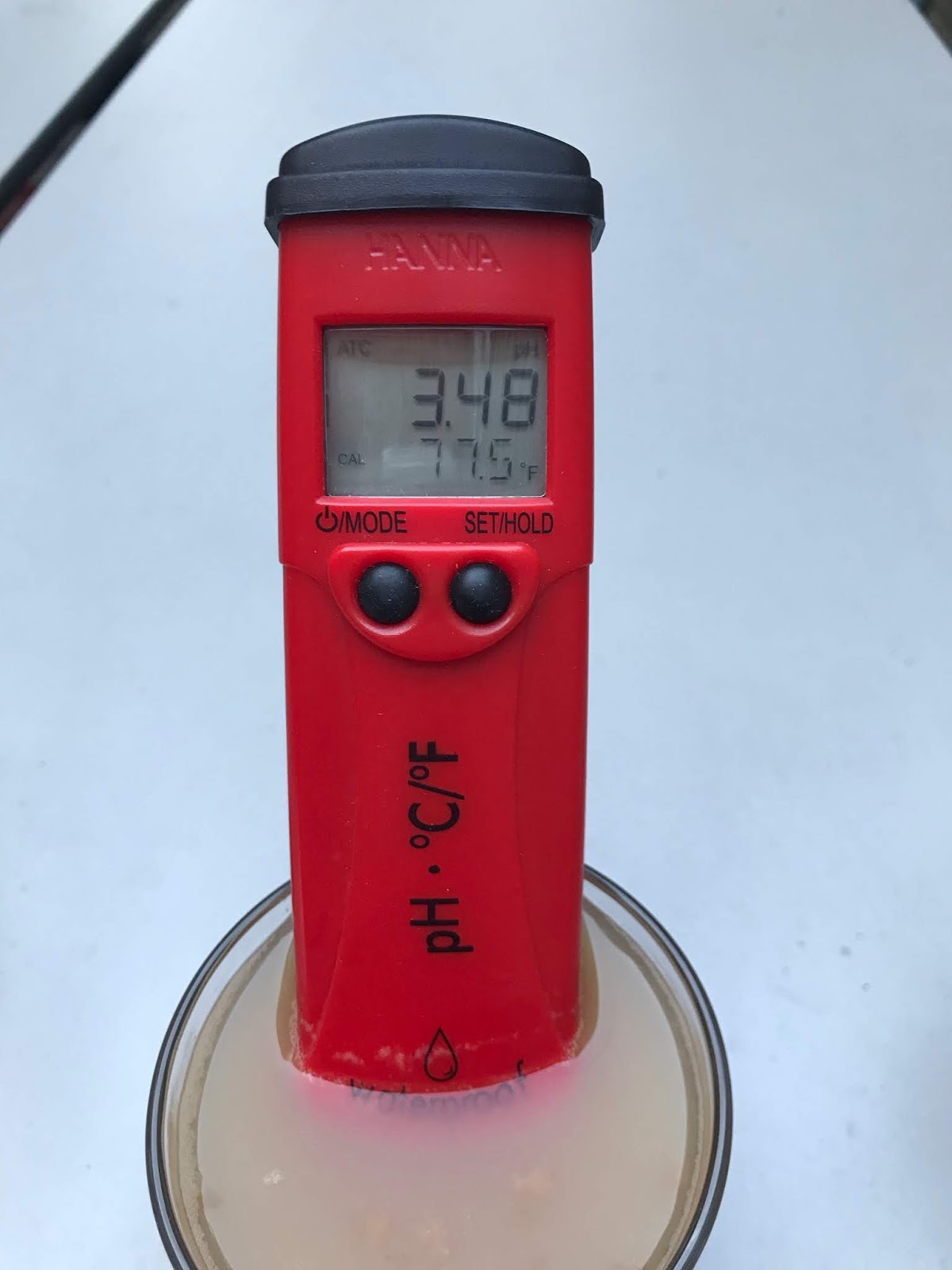
I have not been checking for acid, pH, SO2, and really want to avoid any fiddling.  Still, since I wanted to look at a sample of the must, I took a quickie.  3.48, a tad high and I will test again before moving the wine to carboys.  If I were a really good person I'd also haul out the acid test chems.  (And after hitting 'publish' I tested pH again with more patience: 3.45.)

Some pics: the hopeful empties getting themselves ready; a sample of the must after it's been sitting a few minutes and you can get a feel for just how much yeast and solids are in it; the slightly too high  pH reading.
Hopeful empties.

Settling.  Lots of gunk.
A more patient reading gave me 3.45.


11:30 AM
Hoot, mon! 

We've moved from the primary fermenter to 5+5+5+5+3, leaving a fair amount of very yeasty must behind.  The transfers of the firs four carboys were silky smooth. I decided that rather than have a completely mucky fifth 5 gallon I'd go into a three, but that did not stop the three from being insanely lee-filled and nearly volcanic.  Pictures below tell the story.  The three gallon carboy was so out of control I decided to stick a wine thief into the stopper to create an extra long chimney for the gassing off.  when it calms I'll go back to the bubbler. 
Racking off of the gross lees.


Sunday, November 13, 2016

2016 Chardonnay, day 44, racked

Different levels of clarity.
Jon, Jim and Ron came over to help rack.  We went from 21 gallons to 20.  The first three carboys were all very much alike, but the fourth had much looser lees, clouded when we brought it over to the workbench, and you can see from the photo that the new cb that it went into is much less clear than its fellows.

Taste: still grapey, very tart, but very good for only a month and a half into the process.  Am hoping that some of the acid falls out over the winter, as it has with prior years' wines.  Did not measure.

About 16 ppm free SO2 - will measure again in a few days.  We were pretty good about not agitating the wine much during racking.  Will have to make a decision about whether to leave it alone or not.

Wednesday, October 19, 2016

2016 Chardonnay, day 19: free SO2

06:30
Steady, lazy, medium sized gas bubbles still making their way up the necks of the carboys.  No hurry, nothing frantic, no movement of the airlocks.

Thought I would take a look at free SO2, and true to what the man said about the EC-1118 yeast, it created a bunch of SO2.  I wasn't careful in my measurement and will go back, but the untreated wine is between 20 and 30 ppm.

Saturday, December 12, 2015

2015 Muscat, day 87

SO2 at about 20 PPM.  Will have to decide on whether to give a slight boost at racking and then not touch it again, hoping that this will be the last rack before bottling.  Or leave it alone now and test again next week to see what racking did to the wine?

Acid at about .65% tartaric, or 4.16 ppt sulfuric.  Probably slightly higher, but not much, and that puts us just into the bottom of the range we were shooting for.  (Tasting it at 6:30 in the morning on an unwashed tongue I would have guessed higher.)

Color is great.  Nose isn't remarkable.  I think we're somewhere between the very good 2013 and the OK 2014

Put a couple of carboys up on the bench for racking later today.  The thin lees look like they have crystals in them.  We'll know pretty soon.

No measurement of the rosé yet.

Friday, January 2, 2015

2014 Muscat, day 90, Jan 2 2015

Did a quick check on the Muscat yesterday morning, and getting ready to rack before heading back to work on the 5th.  The wine was about 57F and the cellar maybe a few degrees warmer.  Stopper on CB Charlie was less tight than it should have been and I reseated it.  No testing yet.

Holy moly, testing is done and it's effin good!

10 gal muscat
10 gal muscat on the bench
pH around 4.06 on the meter.  Sulphur around 15 or 16 ppm by Titret.  Acid around .65% tartaric, or 4.2 ppt sulfuric.
partial shift
about 1.5 ml of NaOH 

full color shift
Color shift at 2.6 ml

shift vs wine
color shift vs wine
The acid level is a great relief, given how flat the must seemed, and then how sharp the wine was immediately after primary fermentation.

Color is right on, light lemon yellow.  The nose struck me immediately - for the first time since we started I thought this is delicious!  Mouth-feel was a surprise - I'm sure it went through malolactic fermentation: we did nothing to force it or prevent it, but I guess my mouth wasn't quite expecting it.  

I'm breathing a sigh of relief.  This summer's party is on!

Sunday, October 5, 2014

2014 Muscat, Day 1, Oct 5 2014

0700
Temp outside is 47 F, chilliest morning of the young autumn so far and the first time we've had cool weather on winemaking day in a years.

It's also the latest date we've started Muscat: 2009 9/26, 2010 9/25/, 2011 9/24, 2012 9/29, 2013 9/22).  Last year was the earliest, which maybe makes this year feel all the later.

19:30
Brix +28, juice temp 58.5F, acid 4.5 tartaric, pH 4.3.
Wow!  What a day.  Mihai & Colleen got here first, then Jon, then Helen & Mike, then it's a jumble - Peter, James, Doyle, Michael & Kelly & Nate, Mike & Pam & Carmello, Judy & Danny & Lief... Lots of other folks stopping.

We set up two sorting tables - one in the yard and one on the sidewalk, and we used one of our 50 gallons fermenting drums to hold the sorted grapes until we were ready to press.  Tony Pagano told us yesterday that the grapes were at 28 Brix and I was doubtful, but it was exactly what I was seeing on the refractometer while we worked.  At some point Mihai and I decided not to press while the sorting was going on because we would have to use the wash-up hose for the bladder - turned out to be a mistake in that it stretched the work out for a couple of hours longer than if we pressed (as we usually do) while sorting.
One of Mihai's pics of the sidewalk sorting table - Peter, Jon & Lori.

I think we have the process of using the bladder press down now.  Next year we might elevate it a bit to make the gauge more accessible, we'll know what combination of hoses to have ready, and we'll get a Y splitter so we can press and still have a hose for washing.

Our yield was about 66 liters of juice - more than the last two years but less than 2012 and 11.  Given the condition of the grapes I don't know whether the new press helped get us a better yield, but it's nicer to use - easier for everyone to get a hand in.

At 7:30 or so we tested the juice.  Brix was where we now expected it to be, whopping high.  Acid was correspondingly whopping low - .45 tartaric, and we decided to raise it just as we did last year, to a target .65.  Using the rule of 1 g/l to raise it 1% we uses 2 g/l for 66 liters - 122 g.  That seemed like a heck of a lot, but I went with it.

Also tested for free S02, which was nowhere in sight, and using the rule of .53ml per liter to impart 30 ppm, we added 35ml for the 66 liters.

Then we hydrated the D47 and pitched it in.

During the course of the day Doyle and Peter asked and prodded about doing something with all of the raisened and bruised fruit.  At first I thought we might ferment them on their skins, but then we changed gears, ran them through the destemmer, pressed them, and put the juice (there's only 5 liters of it) into their own container to ferment.  We added appropriate amounts meta, tartaric, and yeast using the same rules as the main wine, though I did not take separate measurements.

Monday, December 2, 2013

2013 Muscat, day 72, Dec 2 2013: testing

I tested the third of the wine that had the least topping off when we racked off the gross lees in October.
  • SO2: 30/35 ppm.  Leaving this alone.  That's about the same reading I got on October 9 from the CB with the middling amount of topping off.  I'm questioning whether the Titrettes need replacing - I didn't mark them for an expiration date.  Might not have wondered this if not for the acid test, below.  The only SO2 adjustment so far was on Sep. 22 when I added about 30 ppm to everything.
  • Acid: Well, the chem kit I have was purchased 13 months ago.  Maybe I need to change it.  If that's not the case, then our acid is off the scale - somewhere above .75% tartaric / 4.8 ppt sulphuric.  I vote for changing the chemicals.  We were at 4.32 on Sep. 24.
  • pH: 3.43.  Sep. 24 measurement was 3.38.

Sunday, March 24, 2013

2012 Muscat A racked

Lori and I racked the Muscat A this morning.  Went from 5+5+5 to... 5+5+5, and here's how.

There was very little loss from the first two 5's.  Turned out to be about a quart each.  So we topped from the third 5, and left ourselves about a half gallon shy in the third.  What to top off with?  The 2012 ramato!  First we did a 9 to 1 bench blend, liked it - actually liked it better than the individual wines - and went ahead and topped off.

Why didn't we like the plain Muscat as much as we expected to?  Testing later I found that the cb we were working from was over-sulfited (50 ppm or more).  The ramato Muscat we were working from was around 20.  I need to go back through each cb and see what the deal is.

The wine is clear enough to go to bottle when we like.  But first we figure out the SO2.

Saturday, March 23, 2013

2012 Merlot and Cabernet Franc racked

About time.  Racked both red wines and added Barrel Mill spirals of medium toast American oak (6 weeks until neutral).

Lost extremely little - the lees were light and thin in the Merlot, much more mucky in the Cab F. but just not a lot of it.  And a little volume was taken up by the oak.  Merlot went from 5+5+5+3+1 to 5+5+5+3.  Cab F was a little more complicated.  We only had 5+3 to start with, and that turned into 5+2.5 or a little more.  So?  Topped off with the remaining Merlot.  All is well.

Haven't added more SO2 - need to think that through and look at when it was last added.  Should probably up the level, since it will be 6 to 8 weeks before we touch it again.  (Now I see it's been 4 months since last SO2 - will definitely add today or tomorrow.)

The Cab F is candy-apple red, clear, not much nose and a little low in acid.  The Merlot is ruby red, has a real attack when you first sip it - acid is up in the white grape range, and I like it a lot.

Cab F pH was about 3.73 at the end of fermentation and it measured 3.71 today.  Need to look to see if we have a pH for the Merlot from the end of fermentation: I see one from the start, which was only 3.27.  Today it measured 3.77.

Tuesday, October 9, 2012

2012 Muscat, Day 11 (Oct 9)

Muscat 1 is bubbling every 4 to 5 seconds, down from every 3 (highly scientific calibration).  Room is at 69.  Took SO2 and PH of both wines.  Muscat 1 3.63 and about 25 ppm.  Ramato 3.7 and about 20 ppm.  Will raise the sulphur in both wines now by about half.

Sunday, June 12, 2011

Preparing to bottle the last of the 2010 Muscat

With a ph of about 6.1 and a current SO2 reading of about 11 ppm, I'm adding about 7 ml of 10% metabisulfite solution to raise the ppm to the low 30's before bottling.  Meanwhile, here's a pic from the pre-party testing:

Sunday, December 5, 2010

2009 Merlot blend, SO2, MLF and topping up

Been meaning to do this for over a month - checked the SO2 levels on the remaining bulk 2009 wine (5+5+1+1), and as expected it was pretty much depleted.  Added 10% solution to get it to about 40 or 50 ppm, opened a bottle we corked in August of 2010 and used it to top off, and replaced the airlocks with solid stoppers.  (Well, really I replaced the airlocks in the orange 2-way caps with solid covers.)

Also tested for MLF (Accuvin) and it looks like that was complete.

My only hesitation in this was whether to bottle one of the carboys instead of capping it: decided to pass on that, and count on what's already bottled plus the 2010 Muscat (plus maybe some of the cal-blend Grimaldi-Savino?) to entertain the wine party crowd in June of 2010.   (If I were less lazy maybe I'd do an MLF test on the August bottle I just opened as a topper?)

Sunday, November 14, 2010

2010 Reds, 5 weeks in

Took a look at the Primitivo, it's possible that the the TA is still 9 g/L and the malic acid is still 110 mg/L, but it's also possible that we're at 8.5 and 75.  Can't tell what's real and what's wishful interpretation of the Accuvin charts.  PH seems to be 3.53, down from 3.57 by meter.  Splitting hairs.

Haven't tested the Cal Blend yet - waiting to see if the Savino Grimaldi clan visits.

Need to consider if we want to rack next week, or wait on a positive change of the malic acid toward 30 mg/L.

Saturday, November 6, 2010

2010 Muscat, 6 weeks in

Ready to rack.
PH 3.61 (meter)
TA 9 g/L
Free SO2 11 ppm by Titret

This was the first use of the meter, and the first use of Titrets.  Love the Titrets!!  (I interpreted Accuvin as 4 ppm, which would have been close enough.)

2010 Reds, one month in

Using Accuvin, both wines show 110 mg/L - unchanged from last week.  Hmmm.  I've known for a long time that I'm not the most color acute person in the world: maybe I'm just not an Accuvin guy?  (But, really, no change from last week.)  Raise the temp in that part of the cellar?

Used the new Hanna meter for the PH.  3.45 on the Cal Blend and 3.58 on the Primitivo.  Last week we tried these tests by Accuvin and settled on 3.8 for the Primitivo and 3.5 for the blend.  I guess in the long run, unless you're making adjustments, using the same test consistently is all you really need, but I'm glad to use an instrument where I can.  I don't see myself setting up lab apparatus to replace the Accuvin.  (But I have priced it out, just for the heck of it...)

Anyway, the thing to think about is whether to try to force the MLF along, and whether we can do it without adversely affecting the Muscat that we want to keep cooler in the same space.

Sunday, October 31, 2010

2009 Merlot, 13 months in

We still have 12 gallons of the 2009 Merlot blend in bulk - two 5 gallon carboys of free run, and two 1 gallon jugs of pressed.  Since we have fresh Accuvin tests laying around, I thought I'd poke into one of the carboys and take a look - these wines had never had free SO2 or malic acid or PH tests done before.
  • Free SO2: about 23 ppm.  That's how I interpret the color chart.  I would have thought lower, but if that's right, I'm happy and ready to boost it.
  •  TA: 6.5 g/L.  Low end of the acceptable range for red.
  • PH: 3.8.  Really?  Really?  (Presque Isle, darn it, send my darned meter so I don't have to do the color chart for this one, eh?).  Well, if it's true, lots of SO2 to add.
  • Malic Acid: 30 to 50 mg/L. 
As a newbie to testing, I'm surprised the PH is so high if the TA is so low.  Happy about the malic acid level. 

I think I'll wait on the delivery of the PH meter before adding SO2.  And we can decide then, too, whether to bottle or leave the wine in bulk.

Saturday, October 30, 2010

2010 Reds, day 22 - readings

Primitivo:
  • PH 3.8, 
  • SO2 18 ppm, 
  • Malic Acid 110 mg/L
We didn't have PH tests (and my meter still hasn't arrived from PI Wine, sigh) when we started, so this is the first reading.  Corresponds to the high acid readings we started with, which we're hoping will be brought down by the MLF.

I think the SO2 is where we want it to be right now, low enough not to inhibit MLF.  Target SO2 for wine this high in PH would be pretty darned high, and if we hit our target Malic Acid, we'll boost the SO2 accordingly.

As with PH, we started the process without a Malic Acid reading, so 110 mg/L is the level we'll ride into next week's tests.  Could have been 2 to 3 times as high at start. Just dunna know.  Target is 30 mg/L.

And for the heck of it, of course I also tasted the juice.  As warned by the yeast sellers, this strain leaves a barnyard nose which dissipates over 6 months of aging: mooooo.   Very tart, but no off tastes at all.

And Mike's come over to test the...
Cal Blend:
  • PH 3.3, 
  • SO2 23 ppm, 
  • Malic Acid 110 mg/L
Wow wow, seeing the different PH readings of the two and then tasting the two is a very short, very clear lesson in what PH does to your mouth.