Two weeks late for the reds, and three weeks late for the whites, we finally racked yesterday. Lori and I started around 9:00 or 9:30 with the primitivo and finished up around 10:00 or 10:30 when Mike got there. Then we racked the blend, and after that the muscat. We were all washed up by noon.
We did all of the work downstairs in the cellar - though I did shovel a path to the cellar trap door and I shoveled most of the back patio if we wanted to or had to wash any of the carboys outside. (I thought we would for the muscat - more below.) I alos set up a 6 foot table in the cellar for us to work off of rather than the small bench.
Started with PH and S02 readings (which I'll fill in below). Did all of our racking without adding meta, but will likely go back and do so to bring things to 40 ppm. Also mixed a new batch of 10% solution, good for a couple of months. Need to order new Accuvin S02 tests (or settle on a replacement).
The primitivo is likely the only one of the wines that suffered for the late racking, and that only because of the barnyard odors of the yeast strain we used. The sooner off those lees, the sooner we lose the funk. And the lees, ladies and gentlemen, defined funk: animal, not vegetal. Couldn't smell anything through the haze, but the taste is clearing and very cherry (I thought). We wound up with an awkward amount of wine and finished in 3x5 and a 1.
The Grimaldi Savino blend is tasting great. Mike says it's the magic of the petit verdot. Who's to say no? Very little mud, and very little loss: 3x5, 1x1, 1x.750.
The muscat is the wine I had been most worried about, never having used bentonite before. I thought the lees were a solid clay and was really worried to have left things the extra weeks. But that was not the case at all. The wine has much more fruit than I remember from this time last year, and a much fresher citrus taste. Because we had 3x750 corked and cold from the first racking we were able to end up about 700 ml short of our 2x5 1x3, so we topped the three with most of a bottle of commercial Alsatian muscat ottonnel. Cousins. Ben @ Slope Cellars sometimes does have a muscat alexandria from CA., but not right now. So that 3 gal. carboy will be a little bit of a trip. We should look down the road to see if we want to blend it. The two fives are straightforward. The three is about two thirds straight stuff, and the remainder is 3/4 cold stabilized and 1/4 commercial.
And - the muscat lees turned out to be fine and soft and easy enough to take care of in the slop sink. All is well.

Monday, February 7, 2011

Sunday, December 5, 2010
2009 Merlot blend, SO2, MLF and topping up
Been meaning to do this for over a month - checked the SO2 levels on the remaining bulk 2009 wine (5+5+1+1), and as expected it was pretty much depleted. Added 10% solution to get it to about 40 or 50 ppm, opened a bottle we corked in August of 2010 and used it to top off, and replaced the airlocks with solid stoppers. (Well, really I replaced the airlocks in the orange 2-way caps with solid covers.)
Also tested for MLF (Accuvin) and it looks like that was complete.
My only hesitation in this was whether to bottle one of the carboys instead of capping it: decided to pass on that, and count on what's already bottled plus the 2010 Muscat (plus maybe some of the cal-blend Grimaldi-Savino?) to entertain the wine party crowd in June of 2010. (If I were less lazy maybe I'd do an MLF test on the August bottle I just opened as a topper?)
Also tested for MLF (Accuvin) and it looks like that was complete.
My only hesitation in this was whether to bottle one of the carboys instead of capping it: decided to pass on that, and count on what's already bottled plus the 2010 Muscat (plus maybe some of the cal-blend Grimaldi-Savino?) to entertain the wine party crowd in June of 2010. (If I were less lazy maybe I'd do an MLF test on the August bottle I just opened as a topper?)
Saturday, December 4, 2010
2010 Reds first racking
Racked both red wines today.
Free SO2 looked to be very low, and we went for a full 50 ppm, adding about a tablespoon of 10% solution to each 5 gallon carboy. (Note to self: need to make another batch of 10% solution before next work - this one is good only through December 8.)
Both wines looked very clean - not very much lost to the lees.
Primitivo went from 5+5+5+5+1 to 5+5+5+5, but had to use a wee but of lees and 750 ml of commercial zinfandel to get there.
Blend went from 5+5+5+3 to 5+5+5+1+1, using a tad of lees and no commercial topper.
All in all, and easy day of work, though way cold outside for the wash-up.
Free SO2 looked to be very low, and we went for a full 50 ppm, adding about a tablespoon of 10% solution to each 5 gallon carboy. (Note to self: need to make another batch of 10% solution before next work - this one is good only through December 8.)
Both wines looked very clean - not very much lost to the lees.
Primitivo went from 5+5+5+5+1 to 5+5+5+5, but had to use a wee but of lees and 750 ml of commercial zinfandel to get there.
Blend went from 5+5+5+3 to 5+5+5+1+1, using a tad of lees and no commercial topper.
All in all, and easy day of work, though way cold outside for the wash-up.
Wednesday, November 17, 2010
Diversion: 100percentcork.org
A trade organization that's advertising on NPR. 100percentcork.org. Cork not just as good for closing wine bottles, but as natural, renewable and supporting biodiversity.
Why 100 Percent Natural Cork from Citizen on Vimeo.
Why 100 Percent Natural Cork from Citizen on Vimeo.
Sunday, November 14, 2010
Staten Island Red, Nov 14
Dipped a tube into one of the carboys yesterday and was very pleased with what I tasted. This is the first time I've done the malolactic fermentation--introduced the bacteria a month ago--and I'm impressed. That sharp, seemingly green edge which has been dominant in all the reds I think I've made through the first year had subsided some, revealing some of the wines fruit--a melange of raspberry and cherry as near as I can tell at this point.
I'll man up the SO2 tomorrow. Doug advises that a tsp of the potassium bisulfate per 5 gal carboy will put me in the vicinity of 40-50 ppm, so that's what I'll do.
2010 Reds, 5 weeks in
Took a look at the Primitivo, it's possible that the the TA is still 9 g/L and the malic acid is still 110 mg/L, but it's also possible that we're at 8.5 and 75. Can't tell what's real and what's wishful interpretation of the Accuvin charts. PH seems to be 3.53, down from 3.57 by meter. Splitting hairs.
Haven't tested the Cal Blend yet - waiting to see if the Savino Grimaldi clan visits.
Need to consider if we want to rack next week, or wait on a positive change of the malic acid toward 30 mg/L.
Haven't tested the Cal Blend yet - waiting to see if the Savino Grimaldi clan visits.
Need to consider if we want to rack next week, or wait on a positive change of the malic acid toward 30 mg/L.
Saturday, November 6, 2010
2010 Muscat, first racking
The plan:
Well, gee, it was just like the plan. Peter came over and we whipped through it. Started with 14 gallons (5+5+3+1) and finished with +13 (5+5+3 3x750 ml). The 750's are pretty gunky, but we're just looking at them as toppers. Don't have proper sized drilled bungs for them, so have corked them and thrown them into the fridge. Will get stoppers and see what can be done.
This is our first use of bentonite.
- Add Bentonite with the racking - 5% slurry based on 1 g Bentonite per 1 gal of wine: so a carboy gets a slurry of 5 g bentonite, 95 g water. Let the slurry sit for 2 hours.
- Boost the SO2 from 12 to 40 or 50 ppm. Will add 2 tsp of 10% solution.
Well, gee, it was just like the plan. Peter came over and we whipped through it. Started with 14 gallons (5+5+3+1) and finished with +13 (5+5+3 3x750 ml). The 750's are pretty gunky, but we're just looking at them as toppers. Don't have proper sized drilled bungs for them, so have corked them and thrown them into the fridge. Will get stoppers and see what can be done.
This is our first use of bentonite.
2010 Muscat, 6 weeks in
Ready to rack.
PH 3.61 (meter)
TA 9 g/L
Free SO2 11 ppm by Titret
This was the first use of the meter, and the first use of Titrets. Love the Titrets!! (I interpreted Accuvin as 4 ppm, which would have been close enough.)
PH 3.61 (meter)
TA 9 g/L
Free SO2 11 ppm by Titret
This was the first use of the meter, and the first use of Titrets. Love the Titrets!! (I interpreted Accuvin as 4 ppm, which would have been close enough.)
2010 Reds, one month in
Using Accuvin, both wines show 110 mg/L - unchanged from last week. Hmmm. I've known for a long time that I'm not the most color acute person in the world: maybe I'm just not an Accuvin guy? (But, really, no change from last week.) Raise the temp in that part of the cellar?
Used the new Hanna meter for the PH. 3.45 on the Cal Blend and 3.58 on the Primitivo. Last week we tried these tests by Accuvin and settled on 3.8 for the Primitivo and 3.5 for the blend. I guess in the long run, unless you're making adjustments, using the same test consistently is all you really need, but I'm glad to use an instrument where I can. I don't see myself setting up lab apparatus to replace the Accuvin. (But I have priced it out, just for the heck of it...)
Anyway, the thing to think about is whether to try to force the MLF along, and whether we can do it without adversely affecting the Muscat that we want to keep cooler in the same space.
Used the new Hanna meter for the PH. 3.45 on the Cal Blend and 3.58 on the Primitivo. Last week we tried these tests by Accuvin and settled on 3.8 for the Primitivo and 3.5 for the blend. I guess in the long run, unless you're making adjustments, using the same test consistently is all you really need, but I'm glad to use an instrument where I can. I don't see myself setting up lab apparatus to replace the Accuvin. (But I have priced it out, just for the heck of it...)
Anyway, the thing to think about is whether to try to force the MLF along, and whether we can do it without adversely affecting the Muscat that we want to keep cooler in the same space.
Buying consortium?
I've met a few other winemakers recently, and I'm wondering if we pooled our dollars, if we could negotiate discounts on some of our supplies. The main thing I'm thinking of at this point is bottles. If we bought, say, 25 cases of bottles, could we get the price down to 50 cents a bottle? Corks, too.
Grapes are trickier, but it might make some sense to explore what we could negotiate if we eliminated the middle man, but the grape is complicated in ways bottles aren't because we'd probably have to get on the same page with a grape to be of interest to a vineyard.
What's everyone think?
Bernardo
Staten Island Red, Nov 6
The wine is quiet and clarifying. Following Doug's advice at PI, I'm going to let the malo-lactic fermentation bug have its way with the wine for another week; then, I'll add S02. Keeping the temp steady at about 64.
Sunday, October 31, 2010
2009 Merlot, 13 months in
We still have 12 gallons of the 2009 Merlot blend in bulk - two 5 gallon carboys of free run, and two 1 gallon jugs of pressed. Since we have fresh Accuvin tests laying around, I thought I'd poke into one of the carboys and take a look - these wines had never had free SO2 or malic acid or PH tests done before.
I think I'll wait on the delivery of the PH meter before adding SO2. And we can decide then, too, whether to bottle or leave the wine in bulk.
- Free SO2: about 23 ppm. That's how I interpret the color chart. I would have thought lower, but if that's right, I'm happy and ready to boost it.
- TA: 6.5 g/L. Low end of the acceptable range for red.
- PH: 3.8. Really? Really? (Presque Isle, darn it, send my darned meter so I don't have to do the color chart for this one, eh?). Well, if it's true, lots of SO2 to add.
- Malic Acid: 30 to 50 mg/L.
I think I'll wait on the delivery of the PH meter before adding SO2. And we can decide then, too, whether to bottle or leave the wine in bulk.
Saturday, October 30, 2010
2010 Reds, day 22 - readings
Primitivo:
I think the SO2 is where we want it to be right now, low enough not to inhibit MLF. Target SO2 for wine this high in PH would be pretty darned high, and if we hit our target Malic Acid, we'll boost the SO2 accordingly.
As with PH, we started the process without a Malic Acid reading, so 110 mg/L is the level we'll ride into next week's tests. Could have been 2 to 3 times as high at start. Just dunna know. Target is 30 mg/L.
And for the heck of it, of course I also tasted the juice. As warned by the yeast sellers, this strain leaves a barnyard nose which dissipates over 6 months of aging: mooooo. Very tart, but no off tastes at all.
And Mike's come over to test the...
Cal Blend:
- PH 3.8,
- SO2 18 ppm,
- Malic Acid 110 mg/L
I think the SO2 is where we want it to be right now, low enough not to inhibit MLF. Target SO2 for wine this high in PH would be pretty darned high, and if we hit our target Malic Acid, we'll boost the SO2 accordingly.
As with PH, we started the process without a Malic Acid reading, so 110 mg/L is the level we'll ride into next week's tests. Could have been 2 to 3 times as high at start. Just dunna know. Target is 30 mg/L.
And for the heck of it, of course I also tasted the juice. As warned by the yeast sellers, this strain leaves a barnyard nose which dissipates over 6 months of aging: mooooo. Very tart, but no off tastes at all.
And Mike's come over to test the...
Cal Blend:
- PH 3.3,
- SO2 23 ppm,
- Malic Acid 110 mg/L
Sunday, October 24, 2010
2010 Reds, day 16: malolactic bugs added
Mike over this morning and we added the bugs and Optimalo to all vessels of both wines. That's a full week after the Cal Blend press and 5 full days after the Primitivo crush.
Also tested TA with fresh Accuvin kits - up around 9 for both wines. We're looking for the MLF to bring it down some. PH meter still hasn't arrived (halloooo, Presque Isle?) so we're just guessing it's hand in hand with the acid.
And ran into Bernardo on the street - he's put the bugs into his Staten Island red: don't know if he also used any nutrients.
Also tested TA with fresh Accuvin kits - up around 9 for both wines. We're looking for the MLF to bring it down some. PH meter still hasn't arrived (halloooo, Presque Isle?) so we're just guessing it's hand in hand with the acid.
And ran into Bernardo on the street - he's put the bugs into his Staten Island red: don't know if he also used any nutrients.
Saturday, October 23, 2010
Let's MLF
I think both groups bought the same malolactic bacteria - Enoferm B - and I'm going to forge on here with that assumption.
The 2.5 g package of EB is good for 66 gallons of wine. We have 21 gallons of Primitivo and 18 gallons of the Merlot / Cab / P. Verdot, so we can use a single package if we're going to work the two wines at the same time.
EB wants to be hydrated in 20 times it's own weight of 20 C chlorine-free water for not more than 15 minutes. 2.5 g package of EB, 50 g water, 50 g water = just a tad over 1/4 cup. So, dump the packet in 1/4 C room temp distilled water and set the timer for 12 minutes.
We're also going to use Optimalo Plus as a nutrient for the malolactic bugs. 1 g per gallon, dissolved in just enough water or wine, and then added and stirred into the body of the wine prior to adding the malolactic bugs. So, use a wine thief to draw off some wine from each vessel, weigh & add proper amount of Optimalo, swish-wait-dump-stir. The Optimalo comes in 6 g packages, so for the 5 gallon carboys we can weigh out the 5 g or eyeball it - you're call.
By the time we've added all of the nutrients we should be ready to add the bugs. Let's use a rule of 1 ml of hydrated bug juice per gallon of wine. I'm basing this on our 1/4 cup = 2 oz = +59 ml for 66 gallons, round it off to 1 ml per gallon and round that to 5 ml per carboy = 1 tsp bug juice. Jah? So add 1 tsp bug juice to the 5 gallon carboys that already have nutrients added, stir, cap, relax.
The 2.5 g package of EB is good for 66 gallons of wine. We have 21 gallons of Primitivo and 18 gallons of the Merlot / Cab / P. Verdot, so we can use a single package if we're going to work the two wines at the same time.
EB wants to be hydrated in 20 times it's own weight of 20 C chlorine-free water for not more than 15 minutes. 2.5 g package of EB, 50 g water, 50 g water = just a tad over 1/4 cup. So, dump the packet in 1/4 C room temp distilled water and set the timer for 12 minutes.
We're also going to use Optimalo Plus as a nutrient for the malolactic bugs. 1 g per gallon, dissolved in just enough water or wine, and then added and stirred into the body of the wine prior to adding the malolactic bugs. So, use a wine thief to draw off some wine from each vessel, weigh & add proper amount of Optimalo, swish-wait-dump-stir. The Optimalo comes in 6 g packages, so for the 5 gallon carboys we can weigh out the 5 g or eyeball it - you're call.
By the time we've added all of the nutrients we should be ready to add the bugs. Let's use a rule of 1 ml of hydrated bug juice per gallon of wine. I'm basing this on our 1/4 cup = 2 oz = +59 ml for 66 gallons, round it off to 1 ml per gallon and round that to 5 ml per carboy = 1 tsp bug juice. Jah? So add 1 tsp bug juice to the 5 gallon carboys that already have nutrients added, stir, cap, relax.
Thursday, October 21, 2010
2010 Reds, day 13
7 AM:
An uptick in bubbling activity from four of the five Primitivo vessels. Two days post zero Brix. Maybe MLF? No similar activity from the Cal Blend, but I may have missed it if it was short lived. So: we need to set the date for adding the MLF bugs and nutrients. Suggestions have been from 2 days post press, to 7.
An uptick in bubbling activity from four of the five Primitivo vessels. Two days post zero Brix. Maybe MLF? No similar activity from the Cal Blend, but I may have missed it if it was short lived. So: we need to set the date for adding the MLF bugs and nutrients. Suggestions have been from 2 days post press, to 7.
Wednesday, October 20, 2010
National Grid confirms: decline of home winemaking in Brooklyn
A meter reader from National Grid was just here. As I led him down to the cellar I apologized for everything being a jumble - I still haven't stowed the press and the primary fermenters and the carboys we didn't use. Now this was an experienced guy I was with, someone who sees a lot of Brooklyn cellars. He said, You don't see much wine making any more. I also do a route in Bensenhurst, and you see a few older Italian guys out there.
Tuesday, October 19, 2010
2010 Reds, day 11
5:30 AM:
Yes, because I'm me I'm already futzing around getting ready.
7 AM:
Press is cleaned, carboys are meta'd, Primitivo is at -0.4 B. Oven is at 500 F and ready to bake a breakfast wine-dough pizza. (I kid you not.) All that's needed now is for some of the partners to awaken. Weather is cool and wet - don't think we've pressed on a rainy day before.
9 AM:
Stunning! Finished pressing, cleaned up, and wondering where we're going to stow the new fermenters and all. Mike & Peter both here to work the wine. Purple breakfast pizza was AOK.
21 gallons total - 15 free flow in carboys + 1 gallon, and a mixed 5 gallons of free flow (2) + press (3). Will start a separate 2010 yield post to track the three wines - all of which started with 8 cases and are in very different places after pressing.
Yes, because I'm me I'm already futzing around getting ready.
7 AM:
Press is cleaned, carboys are meta'd, Primitivo is at -0.4 B. Oven is at 500 F and ready to bake a breakfast wine-dough pizza. (I kid you not.) All that's needed now is for some of the partners to awaken. Weather is cool and wet - don't think we've pressed on a rainy day before.
9 AM:
Stunning! Finished pressing, cleaned up, and wondering where we're going to stow the new fermenters and all. Mike & Peter both here to work the wine. Purple breakfast pizza was AOK.
21 gallons total - 15 free flow in carboys + 1 gallon, and a mixed 5 gallons of free flow (2) + press (3). Will start a separate 2010 yield post to track the three wines - all of which started with 8 cases and are in very different places after pressing.
Monday, October 18, 2010
2010 Reds, day 10
7 AM:
Primitivo is 70 F, 0.2 B. We're set to press it at 8:30 tomorrow morning.
Three of the Cal Blend carboys burped into their bubblers (they were topped off very high) and I've cleaned those up. Looking good.
8 PM:
Primitivo 70 F, -0.3 B. We've shifted press time to 7:30 AM Tuesday. Don't be shy, boys and girls, ther'll be plenty of coffee.
Primitivo is 70 F, 0.2 B. We're set to press it at 8:30 tomorrow morning.
Three of the Cal Blend carboys burped into their bubblers (they were topped off very high) and I've cleaned those up. Looking good.
8 PM:
Primitivo 70 F, -0.3 B. We've shifted press time to 7:30 AM Tuesday. Don't be shy, boys and girls, ther'll be plenty of coffee.
Sunday, October 17, 2010
2010 Reds, day 9
8 AM:
Both musts at 72 F. Cal Blend -0.4 Brix, Primitivo +1.6 Brix. Definitely pressing day for the Cal. Targeting noon. Problem with the Primitivo is we know we cannot crush tomorrow, so if we forgo today we're at Tuesday and an unplanned for extended maceration. We'll decide at noon.
12 noon:
Pressing time for the Cal Blend. 10 gallons free run, 5 gallons 50/50, 3 gallons pressed. Juice was beautiful, and berries in the press cake were very dry. Any more yield and we'd have been busting things.
At about 2 we had the wine-pizza. I made two small ones - and here's the one that's shaped sort of like Africa.

Not a bad thing to do as a tradition, but not something I want to do instead of my usual dough.
8 PM:
Primitivo 72 F, 0.7 B. At this rate we'll be at zero tomorrow morning or noon, but we won't be able to press until Wednesday morning (the 19th). Not ideal, but not terrible. We'll keep a lid on it.
Both musts at 72 F. Cal Blend -0.4 Brix, Primitivo +1.6 Brix. Definitely pressing day for the Cal. Targeting noon. Problem with the Primitivo is we know we cannot crush tomorrow, so if we forgo today we're at Tuesday and an unplanned for extended maceration. We'll decide at noon.
12 noon:
Pressing time for the Cal Blend. 10 gallons free run, 5 gallons 50/50, 3 gallons pressed. Juice was beautiful, and berries in the press cake were very dry. Any more yield and we'd have been busting things.
At about 2 we had the wine-pizza. I made two small ones - and here's the one that's shaped sort of like Africa.

Not a bad thing to do as a tradition, but not something I want to do instead of my usual dough.
8 PM:
Primitivo 72 F, 0.7 B. At this rate we'll be at zero tomorrow morning or noon, but we won't be able to press until Wednesday morning (the 19th). Not ideal, but not terrible. We'll keep a lid on it.
Day 8 (S.I.): full-tilt boogie
To crush is human; to press, divine is what the bard really meant to say.
The must was nearly still when I pressed yesterday. I tried a little of the wine as it came out the press's spout, and it's already showing a display of fruits and notes: I'm getting raspberry and the 1040, sched. D. No, I don't know--raspberry and something. The recipe I used was different from past barbera's simply because Mrs. Lapide was down to 5 crates of barbera--so there's twice the alicante in this wine and almost twice the grenache. We made a 70-20-10 barbera in the past; this one is a 50-30-20.
The yield was 28 beautiful gallons--I thought I'd get 30+. I was thinking 33, but considering how hot and dry the summer was, it's no wonder the yield's a little low. Anyone follow the weather in CA this past summer? Was it as hot and dry as ours?
Going to add the malo-lactic bug tomorrow, and will add some SO2 sometime soon. I think in the anaerobic state I can introduce them together, but I'm not sure.
Saturday, October 16, 2010
Purple pizza
Ever since we read about cakes made with the pressed must I've been hankering to fool around with flour and the wine, so...
Have started a pizza dough using a cup of the still fermenting primitivo must, Montrechet Red Star wine yeast (1 tsp), a little more water, 2 cups all purpose flour and one cup bread flour, 2 tsp. salt. Usually I like to use about 2 or 2.5 cups all purpose and 1/2 or 1 cup whole wheat, but I thought the Montrechet not find tougher access to anything it could eat in the flour very funny.
Going through first rise now. Will report back.

OK, here it is after first rise - which was about the same time it might have been with baker's yeast and water. It's more purple in real life than it appears here in web-safe color land. It smells like, uh, fermenting wine rather than like bread. Will do a second rise and then chill it for use tomorrow. More later. So far so good.
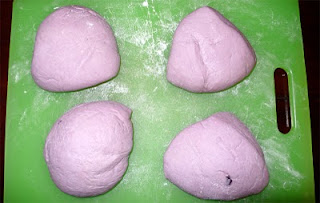
Ahh, the second rise. Didn't color-safe it, so maybe there'll be more to see if you drill in. And I thought it would be nice to do the second rise on a green board.
Have started a pizza dough using a cup of the still fermenting primitivo must, Montrechet Red Star wine yeast (1 tsp), a little more water, 2 cups all purpose flour and one cup bread flour, 2 tsp. salt. Usually I like to use about 2 or 2.5 cups all purpose and 1/2 or 1 cup whole wheat, but I thought the Montrechet not find tougher access to anything it could eat in the flour very funny.
Going through first rise now. Will report back.

OK, here it is after first rise - which was about the same time it might have been with baker's yeast and water. It's more purple in real life than it appears here in web-safe color land. It smells like, uh, fermenting wine rather than like bread. Will do a second rise and then chill it for use tomorrow. More later. So far so good.

Ahh, the second rise. Didn't color-safe it, so maybe there'll be more to see if you drill in. And I thought it would be nice to do the second rise on a green board.
2010 Reds, day 8
7:30 AM:
Mike over to do the honors. Cal B 74 F, 1.3 B. Primitivo 73 F, 3.7 B. We're assuming a press f the Cl B tomorrow, and assuming we will no be pressing the Primitivo tomorrow.
Chatting about when to initiate the MLF. Bernardo says that Doug of Presque Isle recommends two days after pressing, when things are settled and we're not introducing any more oxygen into the wine. Makes good sense to me.
3:00 PM:
Punchdown of both wines, without readings. The ferm still be doing.
It's sharply cooler outdoors today, and the heat has been on in the house a couple of times, but the cellar temperature is unchanged - between 65 and 68 over the last 8 days. This would have been ideal for the Muscat, but when we worked that wine the weather and house were still very warm - 75 to 76 F in the cellar when we crushed, and down to 72 later that week when the wine went to zero Brix. Perverse. Mike's fretted out loud a number of times in the last week about the low temperature of the Cal Blend must - and maybe it would have gone to the 80's if the cellar were in the mid 70's. (I'm guessing Mike goes for a heat girdle next year, just in case.)
Mike over to do the honors. Cal B 74 F, 1.3 B. Primitivo 73 F, 3.7 B. We're assuming a press f the Cl B tomorrow, and assuming we will no be pressing the Primitivo tomorrow.
Chatting about when to initiate the MLF. Bernardo says that Doug of Presque Isle recommends two days after pressing, when things are settled and we're not introducing any more oxygen into the wine. Makes good sense to me.
3:00 PM:
Punchdown of both wines, without readings. The ferm still be doing.
It's sharply cooler outdoors today, and the heat has been on in the house a couple of times, but the cellar temperature is unchanged - between 65 and 68 over the last 8 days. This would have been ideal for the Muscat, but when we worked that wine the weather and house were still very warm - 75 to 76 F in the cellar when we crushed, and down to 72 later that week when the wine went to zero Brix. Perverse. Mike's fretted out loud a number of times in the last week about the low temperature of the Cal Blend must - and maybe it would have gone to the 80's if the cellar were in the mid 70's. (I'm guessing Mike goes for a heat girdle next year, just in case.)
Friday, October 15, 2010
Staten Island Red, Day 7
We're flying at an altitude of about .65 acidity and 68 degrees. Cap has fallen apart and is not reforming. No froth--just some increasingly feeble bubbles each time I stir. I'm going to press tomorrow--aiming for 30-33 gallons of vino. Don't have a brix reading because the hydrometer arrived yesterday, but I'm guessing from the taste of the drops that I let fall into my hand from the stirring stick that I'm in the low single digits.
2010 Reds, day 7
Calibration:
Using plain water, which the short scale hydrometer read as zero or darn close to it, I adjusted the paper scale in the regular hydrometer by nearly 5 B. Squirrels. Haven't yet adjusted the spreadsheets to reflect corrected readings - and of course the long scale may have changed a bit over the week. In another year I'll either resolve to check it every day - or just buy a new one that's less flaky. Anywho...
6 AM:
Cal Blend 77 F and 4.6 B on the real live short scale hydrometer.Still putting up a bug cap, but ferment is calming. Primitivo 76 F and 6.5 B on the newly calibrated long scale. (Lori and I constantly read the thermometer we're using differently - Lori would read this temp as 72.)
And the Muscat... not clear yet but still brightening. This is day 21 for that wine. In 2009 we racked it at day 43 or so (starting from press). That was the same time we racked the reds. This year the white and red will be maybe three weeks apart, I'm guessing.
11:30 PM:
Cal Blend 75 F, 2.3 B; Primitivo 4.7 F and 74 F.Still good sized caps, but obviously less less active underneath when punched down. Random berry tasting has the Primitivo tasting more sweet, and the Cal B tasting... what? tart? Someone else ought to give it a taste.
Time to figure out when the MLF bugs get added.
Sunday press, at least for the Cal B?
Fresh Accuvin acid tests have arrived, and Titret tests that can be used to measure SO2 in the Muscat (but not the red wines).
Using plain water, which the short scale hydrometer read as zero or darn close to it, I adjusted the paper scale in the regular hydrometer by nearly 5 B. Squirrels. Haven't yet adjusted the spreadsheets to reflect corrected readings - and of course the long scale may have changed a bit over the week. In another year I'll either resolve to check it every day - or just buy a new one that's less flaky. Anywho...
6 AM:
Cal Blend 77 F and 4.6 B on the real live short scale hydrometer.Still putting up a bug cap, but ferment is calming. Primitivo 76 F and 6.5 B on the newly calibrated long scale. (Lori and I constantly read the thermometer we're using differently - Lori would read this temp as 72.)
And the Muscat... not clear yet but still brightening. This is day 21 for that wine. In 2009 we racked it at day 43 or so (starting from press). That was the same time we racked the reds. This year the white and red will be maybe three weeks apart, I'm guessing.
11:30 PM:
Cal Blend 75 F, 2.3 B; Primitivo 4.7 F and 74 F.Still good sized caps, but obviously less less active underneath when punched down. Random berry tasting has the Primitivo tasting more sweet, and the Cal B tasting... what? tart? Someone else ought to give it a taste.
Time to figure out when the MLF bugs get added.
Sunday press, at least for the Cal B?
Fresh Accuvin acid tests have arrived, and Titret tests that can be used to measure SO2 in the Muscat (but not the red wines).
Thursday, October 14, 2010
Staten Island Red, Day 6
Situation here:
Purple haze all in my brainIn other words, cake still forming but down to about 2 inches, less warmth, grapes soft and all red-purple, froth diminishing but still present, aroma deepening towards wine.
Lately things just don't seem the same
Actin' funny, but I don't know why
'Scuse me while I kiss the sky.
2010 Reds, day 6
5:30 AM:
Caps are still at their highest. I have the exhaust fan off for the first time this week, and in the relative silence the fermentation vats are gurgling and snap crackle popping away like fools. Cal Blend 77 F and +5 Brix (estimate 6 - see my posting on calibration). Primitivo 74 F and 6 B (which might adjust to 8 or 9). Tasted some of the grapes and there's a definite change now - no longer sweet fruit.
5:30 PM:
Holding temps and caps. Am going to ignore Brix until morning and calibrate the hydrometers then. Neither wine a a true 5 B yet.
9:30 PM
One last punch down for the day.
Caps are still at their highest. I have the exhaust fan off for the first time this week, and in the relative silence the fermentation vats are gurgling and snap crackle popping away like fools. Cal Blend 77 F and +5 Brix (estimate 6 - see my posting on calibration). Primitivo 74 F and 6 B (which might adjust to 8 or 9). Tasted some of the grapes and there's a definite change now - no longer sweet fruit.
5:30 PM:
Holding temps and caps. Am going to ignore Brix until morning and calibrate the hydrometers then. Neither wine a a true 5 B yet.
9:30 PM
One last punch down for the day.
I remember again why I should calibrate that darned hydrometer
Yeah, the old one that doesn't have a visual calibration guide. As we're approaching dry I've switched to the short scale hydrometer (+5 to -5) and it's pretty apparent there's a 2 or 3 Brix disagreement. 3, probably. I'll add an "adjusted Brix" column to the tracking spreadsheet, and note in posts which device I'm using. Begorah.
(The also probably explains the diference between the initial refractometer readings and the initial hydrometer readings.)
(The also probably explains the diference between the initial refractometer readings and the initial hydrometer readings.)
Wednesday, October 13, 2010
Let's get a little geeky, 2010 vs 2009


Yeah, baby, that's what I'm saying. You see it more clearly in the second two charts, where the temps and Brix are done separately. But with the Montrechet yeasts added in jumbo quantities and with crush, temps shot up above 80 and Brix shot downward. (Day 5 for 2009 Brix is an estimate - may well have been zero-ish already.) Will updat ethe charts as we go into days 6 and beyond.
2010 Reds, day 5
6 AM:
Cal B 78 F, 8 Brix, maintaining it's largest cap. Primitivo 76 F and 11.5 B. Not measuring Brix last evening let us shoot past where I wanted to add Fermaid K (which, I know, probably is the best indication that I really don't need to). Did add it this morning, but 20 g rather than the 30 I had in my mind to have added at the 2/3 sugar point.
Cal B is notably looser, but not in the same loose as a goose way of the Primitvo. Mike is hoping for a Sunday pressing.
Afternoon:
[Lori says...] Beautiful - at least a five inch cap and HOT! (though looks like it was just as hot this morning).
8 PM:
Both wines still have their largest caps. CalBlend looks lie 5 Brix on the standard hydrometer, but the short scale hydrometer says we're not there yet. Primitivo looks to be at 8 Brix.
Cal B 78 F, 8 Brix, maintaining it's largest cap. Primitivo 76 F and 11.5 B. Not measuring Brix last evening let us shoot past where I wanted to add Fermaid K (which, I know, probably is the best indication that I really don't need to). Did add it this morning, but 20 g rather than the 30 I had in my mind to have added at the 2/3 sugar point.
Cal B is notably looser, but not in the same loose as a goose way of the Primitvo. Mike is hoping for a Sunday pressing.
Afternoon:
[Lori says...] Beautiful - at least a five inch cap and HOT! (though looks like it was just as hot this morning).
8 PM:
Both wines still have their largest caps. CalBlend looks lie 5 Brix on the standard hydrometer, but the short scale hydrometer says we're not there yet. Primitivo looks to be at 8 Brix.
Tuesday, October 12, 2010
Staten Island Red, Day 4
Big purple froth today. Grapes are cherrying up and softening and making the whole thing look easy. A great day to be a wine maker.
2010 Reds, day 4
6:30 AM
Mike over to punch the CalBlend and add FermAid. 15 Brix - less of a drop from last evening than S expected. Must is 71 F, and coincidentally Mike had dinner last night with someone who's grandfather makes wine and uses heat belts. For comparison sake, last year using Montrechet yeast and with cellar temps running about 2 to 3 degrees higher (two weeks earlier on the calendar) the must temps of the Merlot blend were between 80 and 82 F. When it hit 80 F it was at 15 Brix and 24 hours later it was at 5 Brix. Doesn't seem obvious that we'll have that sort of spike again: let's see.
Primitivo was down to 17.5 Brix, giving off a lot of juice and a lot of big-bubbled froth. Punching down now feels very satisfying.
1 PM:
CalBlend is up 3 F, and down 3 B in 6.5 hours. Primitivo up 1 F and down 1 B. Both are frothy fools.

8:30 PM:
Mike punches down CalB, Lori punches down the Primitivo. Big caps, slight temp rises. We don't measure sugar (and I regret it a little the next morning).
Mike over to punch the CalBlend and add FermAid. 15 Brix - less of a drop from last evening than S expected. Must is 71 F, and coincidentally Mike had dinner last night with someone who's grandfather makes wine and uses heat belts. For comparison sake, last year using Montrechet yeast and with cellar temps running about 2 to 3 degrees higher (two weeks earlier on the calendar) the must temps of the Merlot blend were between 80 and 82 F. When it hit 80 F it was at 15 Brix and 24 hours later it was at 5 Brix. Doesn't seem obvious that we'll have that sort of spike again: let's see.
Primitivo was down to 17.5 Brix, giving off a lot of juice and a lot of big-bubbled froth. Punching down now feels very satisfying.
1 PM:
CalBlend is up 3 F, and down 3 B in 6.5 hours. Primitivo up 1 F and down 1 B. Both are frothy fools.

[The Primitivo prior to 1 PM punchdown. Mike was oohing at the size of the bubbles this morning]
8:30 PM:
Mike punches down CalB, Lori punches down the Primitivo. Big caps, slight temp rises. We don't measure sugar (and I regret it a little the next morning).
Monday, October 11, 2010
Staten Island Red, Day 3
Grapes beginning to soften, liquid increasing--bright purple juice. The cake was about 3 inches before I punched it down. Pink-purple, noisy froth, the aroma is deepening from fruit juice to wine, and the must is throwing off some warmth. It's as robust a fermentation as I've seen.
2010 Reds, day 3
6 AM:
Full bubbling in both wines, but no real cap yet. 1 to 2 inch rises in volume in each. Juice is running berry red, like a smoothy. 10% drop in Primitivo Brix (to about 20) - waiting on testing the Cal Blend to see if M can get here. Waiting on punching (more like shoving) either until someone else is awake. Shall we set 15 Brix as the point for adding Ferm-Aid?
7 AM:
Cal Blend is at 18 Brix. Both wines punched down. It's all very firm - early, but also the first year we only destemmed and did not crush, so we don't know quite what to expect.
1 PM:
Lori says, "Wine was punched at 1pm. Mike and Pam's has gorgeous color!" I noticed the same thing this morning. The Primitivo is berry smoothie colored, the the CalBlend is much richer looking right now.
8 PM:
Both musts to 66 F. CalBlend @ 15.5 Brix and in range for FermAid - Mike will be over in early morning and will add it then. Here's where the yeasts in the two batches are distinguishing themselves: Primitivo is only down to 19 Brix. If the trend continues (as advertised it would) we'll be pressing on different dates. We'll see.
Full bubbling in both wines, but no real cap yet. 1 to 2 inch rises in volume in each. Juice is running berry red, like a smoothy. 10% drop in Primitivo Brix (to about 20) - waiting on testing the Cal Blend to see if M can get here. Waiting on punching (more like shoving) either until someone else is awake. Shall we set 15 Brix as the point for adding Ferm-Aid?
7 AM:
Cal Blend is at 18 Brix. Both wines punched down. It's all very firm - early, but also the first year we only destemmed and did not crush, so we don't know quite what to expect.
1 PM:
Lori says, "Wine was punched at 1pm. Mike and Pam's has gorgeous color!" I noticed the same thing this morning. The Primitivo is berry smoothie colored, the the CalBlend is much richer looking right now.
8 PM:
Both musts to 66 F. CalBlend @ 15.5 Brix and in range for FermAid - Mike will be over in early morning and will add it then. Here's where the yeasts in the two batches are distinguishing themselves: Primitivo is only down to 19 Brix. If the trend continues (as advertised it would) we'll be pressing on different dates. We'll see.
Sunday, October 10, 2010
Staten Island Red, Day 2
I crushed the grapes about 30 hours ago and added the yeast mixture about 24 hours ago, so we are into the second day by all measures. I just stirred the must. There was a cake about two inches thick and some big froth as I poked the board through the cake to stir. The froth is loud, and if you stick your head in the barrell--and who wouldn't?--there's a pleasant miasm of alcohol rising, though everything still smells and tastes pretty sweet. I'll stir it again in the morning.
Staten Island Red
Ciao cugini,
Gina and I went to see Mrs. Lapide yesterday, as I reported in an earlier email, and we bought 5 crates of barbera, 3 of grenache and 2 of alicante. I varied the barbera recipe we used in the past because I had to--Mrs L had only 5 crates of barbera left. Mrs. L gave her blessing to the mix, which was good enough for me. Turns out she and her late husband--born Lorenzo Lapide--made wine for years.
G and I crushed the grapes in the PM--OK, it was mainly me. Grapes were superb: the alicante did a fierce impersonation of black, the barbera was sweet, and the grenache sweet and fruity. No raisining, no rot, no lie. I crushed into 2 barrells because I didn't want to risk overflow from a single barrells. Grapes were room temp when I added the Red Star Montrachet yeast at about 9 P.M.--3 envelopes of yeast per half gal pitcher, plus 1/2 cup of sugar in each pitcher.
We're shooting for about 150 bottles.
Purple froth beginning to appear as of 7 A.M. this morning, and a gorgeous perfume beginning to emanate: a star is born.
The juice that's running from the stirring sticks is already purple and has a sweet taste with fruit--it already has a little alcohol push to it, or my tongue deceives me. Which it does from time to time.
In vino,
Bernardo
2010 Reds, day 2
6 AM: Chart updated with readings. Room cooler, musts slightly warmer. We held of inoculating the musts yesterday to let them come up in temp a bit and feeling OK with having added meta at destemming - an enforced mini-cold soak. The D21 yeast Mike & Pam are using gives "best results" 55 F to 90 F. The fussier D45 that Lori & Peter and I are using is best results 64 F to 82 F, but we'll be pitching at 56 or so. Both yeasts will be mixed with Go-Ferm. Question: add yeast and nutrients on volume of must, or expected yield of juice? There's just under 30 gal of Primitivo must, and just over 25 gal of Cab / Merlot / PV must, but our history with the weight of grapes suggests 20 gallons of juice from each. Oh, it's a mystery. My guess is we'll shoot at the higher numbers.
[1.25 g Go-Ferm for each 1 g yeast. Hydrate the Go-Ferm first in 17 ml water per 1 g Go-Ferm. Then add yeast. Then add to must 15 to 30 minutes later.]
9 AM: We decide to base additions on expected juice, and go with 24 grams yeast, 30 grams Go-Ferm. We follow hydration instructions, and add Crowe's step: at 15 minutes into hydration we add an equal volume of must, and let that stew for another 15 minutes. Then we pitch.
3 PM: Ferm has visibly and audibly started in both wines. Am guessing we're at least a day from any capping.
9:30 PM: Steady as she goes. Temps rising.
[1.25 g Go-Ferm for each 1 g yeast. Hydrate the Go-Ferm first in 17 ml water per 1 g Go-Ferm. Then add yeast. Then add to must 15 to 30 minutes later.]
9 AM: We decide to base additions on expected juice, and go with 24 grams yeast, 30 grams Go-Ferm. We follow hydration instructions, and add Crowe's step: at 15 minutes into hydration we add an equal volume of must, and let that stew for another 15 minutes. Then we pitch.
3 PM: Ferm has visibly and audibly started in both wines. Am guessing we're at least a day from any capping.
9:30 PM: Steady as she goes. Temps rising.
Saturday, October 9, 2010
2010 Reds, a great first day

Everyone was at our place by 9 AM - except Mark, the delivery guy from M&M. We cleaned everything early, moved all of our gear into place. A clear, beautiful day, we set the destemmer up in front of the house. And we waited. Calls back and forth to M&M didn't resolve much, but around 11 the grapes arrived, and they were easily the best looking grapes we've ever bought.
P&M worked theirs first (and they ended in the barrel above on the left). P&L did most of the work on the Primitivo, and they ended in the barrel on the right above.
By 6 PM the musts were still below 55 F, and we decided to wait until AM to pitch the yeasts. (We did add 10% meta solution to the must as we destemmed it, to put the sulfites between 40 ppm and 50 ppm.)
Most notable, I think we're getting a little bit of fermentation starting right off the bat from the wild yeasts on the grapes - not as easy to see in the photos I've taken as it is when you just look in the barrel. [OK, here's a note from the following morning - I'm wrong and just over-anxious.]
By late tomorrow morning I'll have the stats updated. All grapes seemed to be between 24 and 27 Brix on arrival. Acid in the Primitivo seems very high, but we need to get fresh tests, and also we'll be forcing MLF, which should help bring it down. All grapes were sweet to the taste, seeds nutty, very little rot, raisining and mold.
Wednesday, October 6, 2010
2010 red grape delivery confirmed for Saturday, October 9
My message to M&M was that no time can be too early. Driver will call when one hour from delivery. All winemakers on board.
Monday, October 4, 2010
Regime for 2010 Primitivo blend: L&S&P
Will refine this as we go, but as of 10/4, here's what we are looking at.
- Destem and collect both grapes in a single primary. (252# Primitivo, 36# P. Syrah).
- Add 50 ppm potassium metabisulfate to the must. If we base this on expected juice, that will be 1.5 g x 20 (gal) = 30 g. If we do this based on volume of must with skins, we'll add more.
Test for Brix, acid, temp. Target acid will be NN. Adjust acid if necessary. - Prepare yeast, BM45, with Fermaid K and Go-Ferm.
- Inoculate must. No cold soak prior to inoculation.
- Monitor and punch down as necessary. Keep temperature below 85 F. Add ice-packs or dry ice if necessary.
- Unsettled: do we draw off any juice for rose, when, and how much? One day after active fermentation begins and 1 to 3 gallons?
- At 0 Brix test again for acid, and for free S02.
- Inoculate with MLF bugs - DYWM2 Enoferm Beta, 2.5 g - and possibly Opti'Malo Plus 60 g.
- Unsettled: do we try for an extended maceration at this point? How long? Answer will likely depend on how many days it took us to get to 0 Brix and whether we can muster the troops quickly to press.
Subscribe to:
Posts (Atom)