Grenache seems like it's starting to slow - same temp as last evening. Cap maybe a little less vigorous.
Merlot blend seems at it's height. +5" cap, up 1.5' temp from last night.
Grenache same temp as last night, pinprick bubbles have started to form foam over 1/2 surface. Will get Brix this evening.
Muscat temp raised 4.5' from last night to 76.5. 1/2" foam on larger cb, less on smaller. Want to start cooling this. Will check references for optimal temp. Have moved to a hopefully cooler spot in the cellar, and placed cbs into galvanized tubs for icing down.
Everything is where it ought to be, ladies and gentlemen.

Tuesday, September 29, 2009

Monday, September 28, 2009
End of day 2, 2009
Blend climbed 7' from this morning and is down to 15 brix.
Grenache climbed another 5.5', to 82', and it's brix is approaching 10 - very quick (and will want to recalibrate the hydrometer, to be sure).
The caps are at the max on both these wines - Pam and Mike are missing a good show. Punchdowns are psychedelic.
Did not record brix from the Syrah, but it is continuing to be very active, temp 79', same as this morning.
Muscat is starting to do something - ferment or rot - and is only up .5' from this morning at a still cool 72. This is really right on schedule. Should have action in the AM.
The room is the warmest it's been - 72'.
Lots of CO2, lots of grape smell. No flies. Floor is pretty clean.
A boy and his masher
 Ever since seeing a couple of CrushNet videos showing workers doing punchdowns, I've realized that our hereditary approach to punchdowns needed some adjustment. Some oomph. A commercial stainless steel punchdown tool is $85, and I couldn't get my brother to make us one - so today I hit the Bowery, and in the first restaurant supply place I went into I found this lovely mammoth potato masher for $13.95. No tax. Vavoom!
Grenache in Action

The birth of the Savino Grimaldi Family vineyards "Melo's Blend" Genache, Syrah. We are all about the hope now.

The Operation

Thanks to the Lewis Cheatle Family winery for lending us their state of the art operation! Savino Grimaldi Family wine has begun.
Day 2, AM, 2009
Very vigorous caps in the Grenache (76.5') and the Merlot (73.5') blend.
No real start in the Muscat, but the temp is starting to rise. No worries unless there's nothing by tomorrow AM.
Syrah very active pinpricks of CO2, no foam, 79'.
No real start in the Muscat, but the temp is starting to rise. No worries unless there's nothing by tomorrow AM.
Syrah very active pinpricks of CO2, no foam, 79'.
Sunday, September 27, 2009
End of day 1, 2009
Good strong caps in the Grenache and the Merlot blend.
Grenache has risen 6.5' in last 12 hours, and is at 69.5 - above room temp.
Merlot has risen 4.5 degrees in same time period (and is more than double the volume of the Grenache, so the slower delta matches what we've seem in the past.
Lots of pin-prick bubble activity in the Syrah juice.
Nothing yet in the just-yeasted Muscat.
Muscat racked & yeasted
 Racked the Muscat off it's lees, losing abut 2 quarts. Divvied the racked juice between 2 carboys, and yeasted. 70.5', up a few from this morning, and Brix about 21. (Image shows 2 to 3 cm of lees in about 2 gal of juice let sit 24 hours. Juice is still opaque.)
Warrick or Ivers talks about taking the lee-mixed waste at this point, refrigerating it to force the lees to drop again and solidify, and then working the juice back into the working wine. Why not? Am giving it a shot.
 In the racking I forced the racking wand through the new caps we've been buying - works very nicely. You can set the wand at the height you want above the lees and turn your attention elsewhere. (Image: Dude, remember to pull off the venting nipple next time.)
2009 daily readings
I'm publishing this to this link.
I'll also put it in the right hand column.
Nothing notable on 9/27 AM. Punched down at about 9 AM. Light fermentation in grapes and Syrah juice. KSo2'd the Muscat juice lst night to keep things from happening until we rack it today - still the opaqueness of unfiltered cider, but a serious layer of solid lees forming.
Small vessels are at about room temp - which means a nearly 20' change for the Syrah juice. Larger vessels are still cooler by about 5' or 6'.
New press now?
Chat yesterday afternoon about buying a replacement press, as the Barbers' Special will be heading to Staten Island before next year's use. If now, then we'd use it for next week's red press.
It'll be a basket press. The question is 35, 40, or 45 cm diameter basket size. These descriptions are from Grape & Granary:
The larger sizes have double ratchets, the smaller single. Which means only different speeds?
Here's the answer, at leeners.com: "The larger presses #40 & #45 are supplied with a two slot ratcheting head which will operate fast (key in inner slot) or slow (key in outer slot). More pressing torque is available at the slow setting."
Locally, both Lapide and Pagano have the presses (which means no shipping costs, and that can matter given that the presses are damned heavy). If we decide to hold off until next year, we can wait on sales, shop for price, etc.
It'll be a basket press. The question is 35, 40, or 45 cm diameter basket size. These descriptions are from Grape & Granary:
- 35: Basket diameter is 35 cm. Basket dimensions are about 14 inches by 18 inches. 12 gallon capacity basket. Holds 2 cases of grapes uncrushed or 7-10 cases crushed. ($465, single-ratchet.)
- 40: Basket dimensions are about 16 inches by 22 inches. Capacity is 18 gallons. Basket diameter is 40 cm... Holds 3 cases of uncrushed grapes or 11-15 cases of crushed grapes. Diameter of base is 23.5 inches. Overall height of press is 55 inches. ($535, double ratchet.)
- 45: Basket diameter is 45 cm. Basket dimensions are about 18 inches by 24 inches. 25 gallon basket capacity... Holds 4 cases of grapes uncrushed or 15-20 cases crushed. ($670, double ratchet.)
The larger sizes have double ratchets, the smaller single. Which means only different speeds?
Here's the answer, at leeners.com: "The larger presses #40 & #45 are supplied with a two slot ratcheting head which will operate fast (key in inner slot) or slow (key in outer slot). More pressing torque is available at the slow setting."
Locally, both Lapide and Pagano have the presses (which means no shipping costs, and that can matter given that the presses are damned heavy). If we decide to hold off until next year, we can wait on sales, shop for price, etc.
Saturday, September 26, 2009
Opening day, 2009 (day zero)
8:15 AM - Note from B & L saying they are dropping out f the 2009 production. The sound of my jaw slapping against the sidewalk.
8:30 AM - Mike Savino drops in. He & Pam are making wine with us this year!
9:00 ish - We hot the road: Savino and me in one car, James and Peter and Lori in another. Peter is set on Muscat. Lori and I are set on a Merlot - Cab S. blend, somewhere around 75% / 25%. Mike is set on a Rhone blend, if Syrah can be found.
9:30 ish: we haunt Lapide and Pagano. James makes mysterious calls that result in a discount at Lapide. Peter sticks with Muscat. Mike finds Syrah juice at Pagano (Lodi), and buys it to blend with Grenache grapes from Lapide (Pagnani). Steve and Lori decide to change the blend to 70% Merlot, 20% Cab. S., 10% Petite Syrah. We all go with the default yeast of Lapide - Montrechet Red Star.
Until 2:00 ish: after a quick coffee at Provini and Mike picking up Pam, we start by pressing the Grenache (4x36 #), and dividing the Syrah juice (6 gal) between 2 carboys. The juice is very cold (~50'). Pam sets to destemming the Grenache.
We crush the blend into two 50 gal. drums. Lori starts destemming.
I break out the last of the anisette and a little cheese, which keeps James and me from fainting away. James leaves ~ 2:30.
2:30 ish: Lunch! Mike has brought lobster salad and Rolls from the Red Hook Lobster Pound. Life is worth living again.
Until 5:00 ish: Pam yeasts the Grenache and the Syrah juice. The Savinos leave.
Lori continues destemming.
Peter and Steve pick over the Muscat, and crush it, then press it. The grapes taste delicious, but there are a surprising number of broken and browned ones. Crushing yields only about 7 gallons - only half of what we were expecting. Lots of difficulty with the press, and the grapes clearly have a bunch of juice left in them. We divvy the juice between two carboys with the plan of letting it settle for a day, then racking it, then yeasting it. The white juice is the opaqueness of apple cider - we're hoping for a lot of settling.
(I should say that the Merlot grapes were beautiful. The Cab. S, had minimal rot, and the Petite Syrah had a bunch of mild / mildew. All grapes and must tested between 24 brix and 26 brix.)
Until 6:30 ish: Clean-up - Esteban and Nixon from Peters' restaurants come over to help put, breaking up and bundling the crates, washing, etc. An amazing help. Bernardo visits, and brings desperately needed cold beer. We combine the two partial barrels of the blend, and Lori yeasts it. Worried about the white juice sitting for a night, I KSO2 it, 3/4 tsp to the 5 gallons. Caps and airlocks on the white juice and the Syrah juice.
7:30: We're too pooped (long silences, staring) to make good guests at the Savinos' , but not too pooped for Peter to scooch us in to Locali. Then a nightcap at Provini. Then... back to the cellar.
10:30: The Grenache and the blend are both already showing early fermentation signs. There's slight but real bubbling on the Syrah. Photographed everything, and will start the regular measurements in the AM.
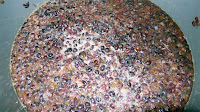
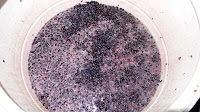
8:30 AM - Mike Savino drops in. He & Pam are making wine with us this year!
9:00 ish - We hot the road: Savino and me in one car, James and Peter and Lori in another. Peter is set on Muscat. Lori and I are set on a Merlot - Cab S. blend, somewhere around 75% / 25%. Mike is set on a Rhone blend, if Syrah can be found.
9:30 ish: we haunt Lapide and Pagano. James makes mysterious calls that result in a discount at Lapide. Peter sticks with Muscat. Mike finds Syrah juice at Pagano (Lodi), and buys it to blend with Grenache grapes from Lapide (Pagnani). Steve and Lori decide to change the blend to 70% Merlot, 20% Cab. S., 10% Petite Syrah. We all go with the default yeast of Lapide - Montrechet Red Star.
Until 2:00 ish: after a quick coffee at Provini and Mike picking up Pam, we start by pressing the Grenache (4x36 #), and dividing the Syrah juice (6 gal) between 2 carboys. The juice is very cold (~50'). Pam sets to destemming the Grenache.
We crush the blend into two 50 gal. drums. Lori starts destemming.
I break out the last of the anisette and a little cheese, which keeps James and me from fainting away. James leaves ~ 2:30.
2:30 ish: Lunch! Mike has brought lobster salad and Rolls from the Red Hook Lobster Pound. Life is worth living again.
Until 5:00 ish: Pam yeasts the Grenache and the Syrah juice. The Savinos leave.
Lori continues destemming.
Peter and Steve pick over the Muscat, and crush it, then press it. The grapes taste delicious, but there are a surprising number of broken and browned ones. Crushing yields only about 7 gallons - only half of what we were expecting. Lots of difficulty with the press, and the grapes clearly have a bunch of juice left in them. We divvy the juice between two carboys with the plan of letting it settle for a day, then racking it, then yeasting it. The white juice is the opaqueness of apple cider - we're hoping for a lot of settling.
(I should say that the Merlot grapes were beautiful. The Cab. S, had minimal rot, and the Petite Syrah had a bunch of mild / mildew. All grapes and must tested between 24 brix and 26 brix.)
Until 6:30 ish: Clean-up - Esteban and Nixon from Peters' restaurants come over to help put, breaking up and bundling the crates, washing, etc. An amazing help. Bernardo visits, and brings desperately needed cold beer. We combine the two partial barrels of the blend, and Lori yeasts it. Worried about the white juice sitting for a night, I KSO2 it, 3/4 tsp to the 5 gallons. Caps and airlocks on the white juice and the Syrah juice.
7:30: We're too pooped (long silences, staring) to make good guests at the Savinos' , but not too pooped for Peter to scooch us in to Locali. Then a nightcap at Provini. Then... back to the cellar.
10:30: The Grenache and the blend are both already showing early fermentation signs. There's slight but real bubbling on the Syrah. Photographed everything, and will start the regular measurements in the AM.


Friday, September 25, 2009
Mudd Lite
The 2006 Mudd that Lori and I love so well is 72.6% Merlot, 19.5% Cabernet Sauvignon, 6.4% Blaufrankisch and 1.5% Dornfelder. Blaufrankisch is dark and spicy, Dornfelder dark and plummy and maybe sweet. Well, we can't but either.
But shooting for a 300 lb / 20 to 25 gallon batch of Mudd lite could be:
(a) 7 cases, 252 #, Merlot, 78% - 2 cases, 72 #, Cab. S. 22% (324 #)
or
(b) 6 cases, 216#, Merlot, 75% - 2 cases, 72 #, Cab. S. 25% (288 #)
0r
(c) 5 cases, 180 #, Merlot, 70% - 2 cases, 72 #, Cab. S. 30% (252 #)
or
(d) 8 cases, 252 #, Merlot, 80% - 2 cases, 72 #, Cab. S. 20% (360 #)
or mix and match a share of the Cab. S. for something your friend might have.
And hello to Mike & Pam
Mike and Pam Savino are interested in making a small amount of wine with us this year. Maybe 2 to 4 crates of Grenache. So I've suggested that Mike pick up a 32 gal. Roughneck and either we'll pick up the grapes for him or he'll meet us at the Market.
Mike's also interested in whites other than Muscat. (If Mike and Pam go white, they should pick up a couple carboys or a carboy and some 1 gal. jugs.)
And, I've sent an invite to Mike for the 11th Street Blog. Howdy, Mike.
Mike's also interested in whites other than Muscat. (If Mike and Pam go white, they should pick up a couple carboys or a carboy and some 1 gal. jugs.)
And, I've sent an invite to Mike for the 11th Street Blog. Howdy, Mike.
Thursday, September 24, 2009
Quick sizing reference
I can never keep this in my head:
1,020 # red grapes = 75 to 80 gal., depending on grapes, press, etc.
1,020 # white grapes = 80 to 85 gal, depending...
1,020 # red grapes = 75 to 80 gal., depending on grapes, press, etc.
1,020 # white grapes = 80 to 85 gal, depending...
A muscat is a muscat is a muscat...
sort of.
The Brooklyn Terminal sellers don't say which muscat they have, but looking at M&M you can see that the central valley and Lodi muscats that they are selling (including Papagni, which is the Lapide source) is Muscat Alexandria. Full reference at wiki. I know Peter is intrigued - he should know:
The Brooklyn Terminal sellers don't say which muscat they have, but looking at M&M you can see that the central valley and Lodi muscats that they are selling (including Papagni, which is the Lapide source) is Muscat Alexandria. Full reference at wiki. I know Peter is intrigued - he should know:
This grape is used for sherry, moscatel or muscatel wines, Moscatel de Valencia, Muscatel Passito and other Muscatel liqueurs and also as a raisin and table grape.and
Wine made from Muscat of Alexandria tends to be sweet with an earthy taste. It is not particularly aromatic. In Málaga the grape is often blended with Pedro Ximénez to create a strong wine that varies in color from gold to dark black. In Australia, the grape is often used in the production of cream sherry. [1] In Portugal, Vinho Moscatel (Moscatel Wine) is a sweet wine widely produced in the Setúbal Peninsula region, just south of Lisbon, as well as in Favaios, Alijó and other areas of the Portuguese Douro, in northern Portugal.I have to say, that makes me curious to see what an 80% muscat, 20% alicante would look like, all pressed as a white wine.
Sunday, September 20, 2009
Obama Sauvignon
I opened a bottle of the Obama and let both of us breathe a little. It's the most effervescent of the wines we have made--I don't know it that means it's still in play to a greater degree than most of our other wines have been. It's a pretty wine--purple and clear but there's still a distinctive aftertaste that's more agreeable but still a little off the spectrum from what cabernet sauvignon serves up--a fusion if I have to put a name to it of naughahide and Schedule B, 2007 1040 EZ.
Trip report: Brooklyn Terminal market
Lori and I visited both Lapide and TP&S (Tony Pagano) today. Here's what we saw.
Confirmed: both have only Central Valley CA grapes. And pretty much the same range of grapes. What Lapide has today (and next week will be similar, but not identical) is:
We also looked at equipment.
Neither shop rents destemmers (damn them) but both sell motorized versions for about a thousand bucks. Pagano also had a hand-cranked destemmer for $600 or $700. All had stainless steel hoppers and painted body parts. The one at Lapide also had some plastic body parts. Pagano had a wider variety of primary fermenters (which I have in mind for the cruel 2010 season when Bernardo will be ensconced on S.I.). We picked up a couple of 5 gal. carboys, since we still have three in the cellar with 2008 and 2007 wine in them.
Anyway, a nice outing. Pagano had more equipment and supplies, but Lapide had more buzz. Damn soon we'll be there buying, no?
(PS: have a new & greatly improved route to the market.
Ocean Parkway to a left on Avenue J.
Avenue J 2.4 miles to a left on Flatlands.
Flatlands .5 miles to a left on 87th.
87th, a coupleof blocks later, is the main entrance to the Market.)
Confirmed: both have only Central Valley CA grapes. And pretty much the same range of grapes. What Lapide has today (and next week will be similar, but not identical) is:
- Alicante, 42#, $38
- Barbera, 36#, $34
- Cab. S., 36#, $39
- Grenache, 36#, $34
- Merlot, 36#, $38
- Zinfandel, 36#, $41
- Sangiovese, 36#, $38
We also looked at equipment.
Neither shop rents destemmers (damn them) but both sell motorized versions for about a thousand bucks. Pagano also had a hand-cranked destemmer for $600 or $700. All had stainless steel hoppers and painted body parts. The one at Lapide also had some plastic body parts. Pagano had a wider variety of primary fermenters (which I have in mind for the cruel 2010 season when Bernardo will be ensconced on S.I.). We picked up a couple of 5 gal. carboys, since we still have three in the cellar with 2008 and 2007 wine in them.
Anyway, a nice outing. Pagano had more equipment and supplies, but Lapide had more buzz. Damn soon we'll be there buying, no?
(PS: have a new & greatly improved route to the market.
Ocean Parkway to a left on Avenue J.
Avenue J 2.4 miles to a left on Flatlands.
Flatlands .5 miles to a left on 87th.
87th, a coupleof blocks later, is the main entrance to the Market.)
Saturday, September 19, 2009
CA grapes
Ciao tutti,
We're for California grapes this time, and though we'd be interested in trying grapes from a more renowned region in CA, we don't have time for a drive to Hartford. Zinfandel is always fun, so is Barbera.
Best,
Bernardo
Sunday, September 13, 2009
Selecting the '09 grapes
Bernardo is wanting to go back to CA grapes.
Steve & Lori both want to hold off on LI grapes until we see where the Cab S. is at next year, and want to go with either CA or WA grapes. More on that, below.
Peter doesn't seem to be as focused on the source of the grapes as the method for gathering them - does not want to do the multi-hour in each direction drive thing.
Re CA grapes:
We've made pretty good wine from the Central Valley grapes we've purchased from Lapide. There are better growing regions to buy grapes from, both CA and WA, at higher cost. Do we want to pursue that? M&M (Hartford) has grapes from 7 WA AVAs and from 8 CA regions (including Central Valley).
Anyone closer sell non CV CA grapes?
I've checked the listings for the Bronx Terminal market, and wine grapes are not included at all. The other provider at the Brooklyn Market is TP&S Winegrapes, Inc.: 718-209-4108.
M&M deliver?
We need to decide very soon.
Tasting the 08 Cab S
We tasted the Cheatle / Lewis and the Sclafani '08 Cab S. today.
Comparing the 2, the nose of the Sclafani is smoother. I'm guessing this is from it's being lower alcohol. Color is very similar, and I think it's just where we expect and want for it to be. Does the Sclafani taste under-proof? Can't quite tell, because...
The C/L seems a bit bitter and the Sclafani seems a bit tart. Sigh.
Our assumption is that time will continue to improve things, and we do have time. Might want to replace the Sc. carboy for the 09 production. Leave the C/L in the tank until at least after the 09 racking: at that point we'll decide to leave the 09 L/C in carboys or bottle the 08 or... buy another aging tank? (Cha-ching!)
We decided that if the oak is floating in the C/L we'd remove it now - but it's not: it's sunk to the bottom. Need to decide whether to go fishing.
Last note - when we re-inflated the lid the tank was not completely level, and after a couple of minutes it actually popped off. Moved it now to a level spot, have inflated it to 0.5 bar rather that 0.7 bar. Will make sure it stays put, then go up by .1, repeat.
Wednesday, August 26, 2009
Grape choices for 2009
I know B is leaning toward California grapes. Lori, I think is interested in looking widely. I think I'm leaning toward north fork again. Lori's mentioned trying to hok up with the Red Hook operation to buy grapes with them, to get better quality and lower price.
Starting to think about it for real, I've been poking into the M&M site - the folks up in Hartford that I've often seen ads for. Wide variety of grapes from a wide variety of California growers. I like this harvest reference page. They also sell juice from Washington, Chile, etc.: will call them to find out if they wil bring in WA grapes.
Starting to think about it for real, I've been poking into the M&M site - the folks up in Hartford that I've often seen ads for. Wide variety of grapes from a wide variety of California growers. I like this harvest reference page. They also sell juice from Washington, Chile, etc.: will call them to find out if they wil bring in WA grapes.
Sunday, July 26, 2009
Ugh. Wrong gasket.
Well, the PI folks disagreed about which gasket to send, Doug made the decision, and unfortunately what they've sent is wrong two ways: wrong diameter & the valve does not fit through the opening in the tank's lid. Sigh.
Of course, that wasn't clear until I'd taken everything apart.
Sooo... I gave the lid and old gasket a super-hot cleaning, hot tap and boiling water. There was indeed more mold around the upper perimeter of the gasket in some spots, but nothing at the bottom and no trace of anything at the surface of the wine.
And tasting: much relieved of my secret fears. Except that it tastes young yet, we're going down a good path.
With all of these gasket looks and lid-offs, this batch is getting more oxygen than I'd like, but I don't see that there's anything to do for it except xfer to carboys (which itself would be a lot of airing) and give up on the tank for the season. Let's see if the cleaned gasket holds or if I can get a proper replacement.
Tuesday, July 14, 2009
Pagano truck siting in the hood

Sent via thingy.
New gasket
Have ordered a new gasket for the 100 gal. steel tank. Have been losing pressure every coupl eof days, and a mold is forming where the valve comes through the lid and attached to the tube to the pump / pressure gauge.
Have cleaned everything.
Tasted on Sunday - I'm worried, but then I brushed my teeth with anise toothpaste just before tasting. Lori thinks it's OK. Will taste again when the new gasket arrives.
I guess this is the potential downside of a single bulk-aging vessel. It would be a lot to lose.
Presque Isle was also a little shaky on this - Debbie Lam and Doug giving directly contradictory info on which gasket to but. We're going with the AG45, for a 100 liter tank approximately 30 inches tall and 18 inches in diameter.
Saturday, July 11, 2009
Holy Moly - 2006 winemaking notes
Just ran into these notes, and decided to post them for posterity.
( Saturday, October 7, 2006 -- Making this first entry a week after we started, relying on memory.
060930 - Went Saturday AM, Sep. 30 to Lapides market in the Brooklyn Terminal Market. This is where Bernardo & his winemaking friends have been buying grapes in memory. At 8 AM most of the other customers there seemed to be other home winemakers.
Palettes of different types of grapes outside the building. Walking from palette to palette and pulling individual grapes from the sides of crates we tasted alacante (very juicy), merlot, zinfandel, grenache (unbelievably sweet), and others that I'm not remembering.
Spoke with Mrs. Lapide - I think we had already been leaning toward zinfandel, talked to her about blending and she thought blending with the alacante would save us money and "achieve the same goal", by which I took her to mean having zinfandel wine. The ration she figured would work was 10 cases zinfandel, four alacante bouchet, and that's what we settled on.
The zinfandel grapes were 36 lbs. to the crate, and the alacante 42 lbs. to the crate - that's 528 lbs. of grapes. I think the total cost, with some chemicals, yeast and an odd or end was 490. initial plan was to use existing carboys and jugs, existing poly drum, existing crusher and existing wood barrel.
Got the grapes to 438 11th. Washed them by the 1/2 crate and carried them to the cellar where we crushed them into the poly. When we were just more than half through the grapes we were two thirds full in the poly, so went to fetch a second one from 3rd Street (yes, the drum fits in the back of the Mini) - washed and crushed the remaining grapes into that.
All the barrels and tools and our own hands we washed in a solution of water and potassium metabisulfite - 3 tsp to a gallon. After the initial washings we kept a 5 gallon bucket of the solution on hand for washing our paddles and tools and hands.
The washing of the grapes we did consisted only of hosing them and checking for rot or raisins and removing them. (I subsequently read in the Presque Isle pamphlet that they are not a fan of washing - but to pick for rot & raisins.)
After lunch we dove into the grapes to pull out what stems we could. Bernardo's approach was ernest, but not religious. I'm guessing we removed half the stems.
The yeast we bought was Montrachet yeast. Bernardo had more packets of another Montrechet yeast variety, and he wound up making a mixed batch of both - I need to get the proportions. Yeast was mixed Saturday afternoon, frothed, and poured into the grapes around 8 PM Saturday evening.
At the end of the day the only things we had introduced into the grapes was the yeast and whatever water & potassium metabisulfite might have been left on our hands or the tools.
061001 -
Sunday. About 6:15 AM, first stirring after yeast had been added (about 10 hours prior). No greatly noticeable difference. Grapes floating on juice, bit not obviously giving up their own juice, and little bubbling or fermenting.
That evening the floating grapes were more obviously formed into a cap a few inches thick. Active fermenting had really started.
061002 -
Monday. Have pictures from that morning - cap is 4 inches thick. Foam and fermentation is very active.
Evening - foam and fermentation is now breaking through the cap. Everything is wildly alive. Lots of effervescence - very heady when you get your face into the barrel. The whole house now smells of something between grape and wine. The juice is quite warm.
Bernardo, on advice from the master, Bernard, judges this is a good time to add something to help the structure (huh?) of the wine. This is practice in the group, not based on measurement. So, in goes the tartaric acid. Need to check with Bernardo re the quantity we added.
When the cap was fully broken up and the juice stirred the foam from fermentation was vivid in color and almost taffy or meringue-like in volume and glossiness and volume.
061003 & 060104 -
Tuesday and Wednesday. The cap crests at about 6 inches. Lots of deepening nose, lots of effervescence. Fermentation still very active, but does not approach again the witches' cauldron of Monday evening. Moisture collects o the underside of the plastic we cover the drums with. A sense that the grapes are further desiccating. Continue breaking up the cap and stirring twice a day. No other chemicals are added.
I pick up a thermometer for the cellar. Bernardo had been concerned, I think, that we were too warm. We installed a little venting fan earlier in the week to cool & help get some of the gasses out. But the Presque Isle pamphlet and subsequent reading calls for red wine first fermentation at 75 to 80 F. We're between 70 & 75 now. But will likely go warmer as the furnace kicks in and it cools outside. Might want to replace the venting fan with the original pane of glass.
061005 & 060106
Thursday and Friday. Fermentation seems to be tailing off. The cap is decreasing, less structure each time we stir. Bubbling from fermentation is finer, and all bubbles dissipate within a minute or two of breaking up the cap. Still effervescence above the juice. The color of the juice is deep purple, and it's very opaque.
Friday evening we prepare the carboys for the first racking on Sunday, washing them with plain water.
061007 -
Saturday. Much like Friday evening. Deep color. Very little structure to the cap. Foam all dissolves within a minute or two of beginning to stir.
061008
Sunday - Am reading in Jon Iverson's Home Winemaking, Step by Stepre potassium metabisulfite -
Duh. Likely the reason I often feel a small asthmatic episode starting when I have my fist sips of red wine. Also may be why I had one when I dipped my head into the barrel a few days ago when stirring. Thought I might have been winded from schlepping the carboys around, but maybe not.
Pressing day. Started clearing space in the cellar around 7:30. Gathered the press and odds & ends over to 11th Street. The press had a section of railroad rail as the top cross to it's frame - all heavy as hell. Managed to get everything into the cellar, sulfite washed & ready to rock still early.
Poured grapes from both poly drums in equal amounts so that all of the carboys will have pretty much the same blend of alicante and zinfandel.
Ran the press once and thought we would run it just a second time, but started thinking it would be awfully full and we would not get as much juice as three presses. Wound up filling 8 carboys plus 1 3 liter jug plus one 2 liter jug plus (for yucks) two wine bottles. Used a mix of intestine style and inverted jelly jar style gas gismos (which must have some more common name. Bernardo carried off the skins and stems for compost.
( Saturday, October 7, 2006 -- Making this first entry a week after we started, relying on memory.
060930 - Went Saturday AM, Sep. 30 to Lapides market in the Brooklyn Terminal Market. This is where Bernardo & his winemaking friends have been buying grapes in memory. At 8 AM most of the other customers there seemed to be other home winemakers.
Palettes of different types of grapes outside the building. Walking from palette to palette and pulling individual grapes from the sides of crates we tasted alacante (very juicy), merlot, zinfandel, grenache (unbelievably sweet), and others that I'm not remembering.
Spoke with Mrs. Lapide - I think we had already been leaning toward zinfandel, talked to her about blending and she thought blending with the alacante would save us money and "achieve the same goal", by which I took her to mean having zinfandel wine. The ration she figured would work was 10 cases zinfandel, four alacante bouchet, and that's what we settled on.
The zinfandel grapes were 36 lbs. to the crate, and the alacante 42 lbs. to the crate - that's 528 lbs. of grapes. I think the total cost, with some chemicals, yeast and an odd or end was 490. initial plan was to use existing carboys and jugs, existing poly drum, existing crusher and existing wood barrel.
Got the grapes to 438 11th. Washed them by the 1/2 crate and carried them to the cellar where we crushed them into the poly. When we were just more than half through the grapes we were two thirds full in the poly, so went to fetch a second one from 3rd Street (yes, the drum fits in the back of the Mini) - washed and crushed the remaining grapes into that.
All the barrels and tools and our own hands we washed in a solution of water and potassium metabisulfite - 3 tsp to a gallon. After the initial washings we kept a 5 gallon bucket of the solution on hand for washing our paddles and tools and hands.
The washing of the grapes we did consisted only of hosing them and checking for rot or raisins and removing them. (I subsequently read in the Presque Isle pamphlet that they are not a fan of washing - but to pick for rot & raisins.)
After lunch we dove into the grapes to pull out what stems we could. Bernardo's approach was ernest, but not religious. I'm guessing we removed half the stems.
The yeast we bought was Montrachet yeast. Bernardo had more packets of another Montrechet yeast variety, and he wound up making a mixed batch of both - I need to get the proportions. Yeast was mixed Saturday afternoon, frothed, and poured into the grapes around 8 PM Saturday evening.
At the end of the day the only things we had introduced into the grapes was the yeast and whatever water & potassium metabisulfite might have been left on our hands or the tools.
061001 -
Sunday. About 6:15 AM, first stirring after yeast had been added (about 10 hours prior). No greatly noticeable difference. Grapes floating on juice, bit not obviously giving up their own juice, and little bubbling or fermenting.
That evening the floating grapes were more obviously formed into a cap a few inches thick. Active fermenting had really started.
061002 -
Monday. Have pictures from that morning - cap is 4 inches thick. Foam and fermentation is very active.
Evening - foam and fermentation is now breaking through the cap. Everything is wildly alive. Lots of effervescence - very heady when you get your face into the barrel. The whole house now smells of something between grape and wine. The juice is quite warm.
Bernardo, on advice from the master, Bernard, judges this is a good time to add something to help the structure (huh?) of the wine. This is practice in the group, not based on measurement. So, in goes the tartaric acid. Need to check with Bernardo re the quantity we added.
When the cap was fully broken up and the juice stirred the foam from fermentation was vivid in color and almost taffy or meringue-like in volume and glossiness and volume.
061003 & 060104 -
Tuesday and Wednesday. The cap crests at about 6 inches. Lots of deepening nose, lots of effervescence. Fermentation still very active, but does not approach again the witches' cauldron of Monday evening. Moisture collects o the underside of the plastic we cover the drums with. A sense that the grapes are further desiccating. Continue breaking up the cap and stirring twice a day. No other chemicals are added.
I pick up a thermometer for the cellar. Bernardo had been concerned, I think, that we were too warm. We installed a little venting fan earlier in the week to cool & help get some of the gasses out. But the Presque Isle pamphlet and subsequent reading calls for red wine first fermentation at 75 to 80 F. We're between 70 & 75 now. But will likely go warmer as the furnace kicks in and it cools outside. Might want to replace the venting fan with the original pane of glass.
061005 & 060106
Thursday and Friday. Fermentation seems to be tailing off. The cap is decreasing, less structure each time we stir. Bubbling from fermentation is finer, and all bubbles dissipate within a minute or two of breaking up the cap. Still effervescence above the juice. The color of the juice is deep purple, and it's very opaque.
Friday evening we prepare the carboys for the first racking on Sunday, washing them with plain water.
061007 -
Saturday. Much like Friday evening. Deep color. Very little structure to the cap. Foam all dissolves within a minute or two of beginning to stir.
061008
Sunday - Am reading in Jon Iverson's Home Winemaking, Step by Stepre potassium metabisulfite -
Some people are allergic to sulfites and asthmatics are are particularly sensitive to it...
Duh. Likely the reason I often feel a small asthmatic episode starting when I have my fist sips of red wine. Also may be why I had one when I dipped my head into the barrel a few days ago when stirring. Thought I might have been winded from schlepping the carboys around, but maybe not.
Pressing day. Started clearing space in the cellar around 7:30. Gathered the press and odds & ends over to 11th Street. The press had a section of railroad rail as the top cross to it's frame - all heavy as hell. Managed to get everything into the cellar, sulfite washed & ready to rock still early.
Poured grapes from both poly drums in equal amounts so that all of the carboys will have pretty much the same blend of alicante and zinfandel.
Ran the press once and thought we would run it just a second time, but started thinking it would be awfully full and we would not get as much juice as three presses. Wound up filling 8 carboys plus 1 3 liter jug plus one 2 liter jug plus (for yucks) two wine bottles. Used a mix of intestine style and inverted jelly jar style gas gismos (which must have some more common name. Bernardo carried off the skins and stems for compost.
Thursday, July 9, 2009
A visit to the North Fork - and all that early rain
Lori and I spent four days out on the North Fork last week. Visited Old Field, Shinn, The Tasting Room, Wolffer, and Channing Daughters (and bought wine everywhere). Drove by the vineyard where we bought the 2008 Cab S. grapes and saluted.
Spoke to the folks at Channing about how the weather (soggy, soggy June) might affect this year's grapes. The answer is that since there is no fruit on the vines yet, there's no affect to the fruit, but it's been a great deal of work for the vineyard workers to prevent mildew and any associated problems.
I'd already noticed that there was no fruit on the vines (or just the nubs of fruit beginning on some). Very different than the Concord vine in the Brooklyn back yard, which already have marble-sized fruit, and lots of it.
Friday, June 5, 2009
Three pretty different treatments of the 2008 Cabernet S.
I thought it might be good to pull what we know about our 2008 wine production into one post, which we can update & refine. I'm urged to do this by Laura and Bernardo's tasting notes from last week, and by what different schedules we've put the three batches on.
I'll refer to the batches as: Sclafani, Dawson / Pace, and Cheatle / Lewis.
Grapes - no differences
All three batches started with identical grapes, Cab. S., from Michael Kontokosta, grown in Greenport, L.I., picked in the late afternoon of the day prior to our use. The grapes were lower brix than we used previously, and that leads, below, to some of the differences in the treatment of the batches. We all had the grapes crushed in less than 24 hours from their being picked.
Crush, and destemming - differences
October 25. Crush was identical, but destemming was not. How to characterize it? Dawson / Pace destemming was light to moderate, and Sclafani and Cheatle / Lewis destemming was obsessive and maximal.
Primary fermentation - no differences
The Dawson / Pace and Cheatle / Lewis batches were in 55 gal food-grade drums, and the Sclafani batch in a 32 gal roughneck. No specific measurements here, but a third of the grapes went into the Dawson / Pace drum, more than a third into the Cheatle / Lewis drum, and less than a third into the Sclafani roughneck. Cheatle / Lewis to share some of their batch back to Sclafani.
All batches had pectic enzyme added immediately following crush - 1 dropper per 11 lb of grapes, as best we could estimate.
The same yeast - Lalvin RC 212 - was used in each batch.
The batches fermented similarly through the first [N] days, with temperature and speed variations tied, I think, mostly to their different batch sizes.
Punchdowns were identical (twice daily) for all batches.
Chapitizing - differences
I drove everyone a little nuts because I was using a refractometer as the wine approached dry, and was getting false readings. By October 30 fermentation was still.
Pace conferred with Presque Isle, and decided to add sugar to come to an approximate 12% alcohol level.
Sclafani opted out, and decided to go with whatever the grapes would yield.
Dawson / Pace added 5 lb sugar directly to the drum, & stirred.
Cheatle / Lewis mixed 5 lb sugar over low heat with 1/2 gal of juice & must, let it cool, and mixed this syrup back into the drum.
MLF - no differences
Nov. 1 brix was back under one for the Dawson / Pace and Cheatle / Lewis batches. Nov. 2 we divided 1.5 g. of freeze dried malolactic bacteria amongst the three batches, in proportions attempting to match the batch sizes.
Pressing - no differences
All batches were pressed on Nov.2. Yields were
Stirring the lees - differences
A week after pressing, Cheatle / Lewis stirred the lees of their batch, looking to promote the MLF, etc. Offered the idea to the other partners, who did not take them up on this.
Secondary fermentation - possible differences
Noted in the blog 28 days after pressing, one Dawson / Pace carboy was still bubbling. It's behavior was different than all other carboys. Dawson / Pace moved their carboys to Bernardo's cellar 3 days later (Dec. 2). Don't know if the wine from that bottle was tracked after that.
1st racking - differences
I'll refer to the batches as: Sclafani, Dawson / Pace, and Cheatle / Lewis.
Grapes - no differences
All three batches started with identical grapes, Cab. S., from Michael Kontokosta, grown in Greenport, L.I., picked in the late afternoon of the day prior to our use. The grapes were lower brix than we used previously, and that leads, below, to some of the differences in the treatment of the batches. We all had the grapes crushed in less than 24 hours from their being picked.
Crush, and destemming - differences
October 25. Crush was identical, but destemming was not. How to characterize it? Dawson / Pace destemming was light to moderate, and Sclafani and Cheatle / Lewis destemming was obsessive and maximal.
Primary fermentation - no differences
The Dawson / Pace and Cheatle / Lewis batches were in 55 gal food-grade drums, and the Sclafani batch in a 32 gal roughneck. No specific measurements here, but a third of the grapes went into the Dawson / Pace drum, more than a third into the Cheatle / Lewis drum, and less than a third into the Sclafani roughneck. Cheatle / Lewis to share some of their batch back to Sclafani.
All batches had pectic enzyme added immediately following crush - 1 dropper per 11 lb of grapes, as best we could estimate.
The same yeast - Lalvin RC 212 - was used in each batch.
The batches fermented similarly through the first [N] days, with temperature and speed variations tied, I think, mostly to their different batch sizes.
Punchdowns were identical (twice daily) for all batches.
Chapitizing - differences
I drove everyone a little nuts because I was using a refractometer as the wine approached dry, and was getting false readings. By October 30 fermentation was still.
Pace conferred with Presque Isle, and decided to add sugar to come to an approximate 12% alcohol level.
Sclafani opted out, and decided to go with whatever the grapes would yield.
Dawson / Pace added 5 lb sugar directly to the drum, & stirred.
Cheatle / Lewis mixed 5 lb sugar over low heat with 1/2 gal of juice & must, let it cool, and mixed this syrup back into the drum.
MLF - no differences
Nov. 1 brix was back under one for the Dawson / Pace and Cheatle / Lewis batches. Nov. 2 we divided 1.5 g. of freeze dried malolactic bacteria amongst the three batches, in proportions attempting to match the batch sizes.
Pressing - no differences
All batches were pressed on Nov.2. Yields were
- 20 gal Cheatle / Lewis, including going back to the pressed must for a little more;
- 16 gal Dawson / Pace;
- 10 gal Sclafani (and, remember, some of the Cheatle / Lewis wine for to Peter to even things out).
Stirring the lees - differences
A week after pressing, Cheatle / Lewis stirred the lees of their batch, looking to promote the MLF, etc. Offered the idea to the other partners, who did not take them up on this.
Secondary fermentation - possible differences
Noted in the blog 28 days after pressing, one Dawson / Pace carboy was still bubbling. It's behavior was different than all other carboys. Dawson / Pace moved their carboys to Bernardo's cellar 3 days later (Dec. 2). Don't know if the wine from that bottle was tracked after that.
1st racking - differences
- Cheatle / Lewis, Jan 4, 2009. Added K2S2O5 , about 3/4 teaspoon per 5-gal, which I think translates to 45 parts per million. Pretty liberal with aerating the wine.
- Dawson / Pace, Jan 13, 2009. No sulfur added. (Oaked at this time - see below.) All three carboys tasted identical. Noted a little fizz.
- Sclafani, Jan 25. No sulfur. Topped up one of the CBs with about 3 liters of mixed wine for Cheatle / Lewis.
- Cheatle / Lewis, Mar 21, 2009. No sulfur. All wine was racked together into the 100 liter steel tank.
- Dawson / Pace, no 2nd racking - see oaking notes.
- Sclafani, June 5, 2009. (Not a typo.) No sulfur. Racked into clean carboys, and topped up with wine from Cheatle / Lewis batch.
- Cheatle / Lewis, April 10, 2009. Used Barrel Mill spirals. 4 medium toast American oak, 2 medium toast French oak, in the prescribed proportion - one 8" spiral per 3 gallons of wine. These spirals are still in the wine as of this writing.
- Dawson / Pace, January 16, 2009. Used heavy toast for one week and removed. (Barrel Mills? American or French?)
- Sclafani, June 5, 2009. Used Barrel Mills medium toast American oak in the prescribed quantity.
- Cheatle / Lewis: except for a little wine to be used at the 2009 party, and tasting as it goes, we intend to bulk age the wine, with the oak in, until the tank is needed again next year. That puts bottling at late winter, 2010.
- Dawson / Pace: bottled in early February, 2009. [Need date.]
- Sclafani: no stated plan. Minimal oak-ready, July 17, 2009.
Sclafani 2008 2nd racking and oak, at last
Peter stopped by to rack his 2008 wine.
Very little sediment (he sacrificed wine in the first racking and it looks like it paid in the second). Color the same as the Cheatle / Lewis batch.
Added Barrel Mill medium toast American oak spirals, and topped up the 2nd carboy with wine (a gallon or less) from the Cheatle / Lewis batch.
Very little sediment (he sacrificed wine in the first racking and it looks like it paid in the second). Color the same as the Cheatle / Lewis batch.
Added Barrel Mill medium toast American oak spirals, and topped up the 2nd carboy with wine (a gallon or less) from the Cheatle / Lewis batch.
Monday, June 1, 2009
Tasted the 2008
Just a short note to say that the bottle Laura and I sampled on Friday, May 29, began well but finished badly. What I mean is that each sip started nicely--dry with nameless fruit and some spice--but finished with a sour after taste. Steve and Lori, did you try some on Memorial Day?
Sunday, May 3, 2009
Sage & pistachio follow-up
Strained and sweetened and filtered the liqueurs we're targeting for the June 13 party.
The sage / lemon is a beautiful, clear yellow. Very attractive. Very lemon scented. Really didn't need filtering.
The pistachio was a real hassle. I realized I chopped the nuts too fine when I started it, but decided to go forward anyway. Took only a couple of days to develop into 80% green mud and a little clear-floating alcohol on top. Ran it through a cheesecloth strain first, and squeezed out what I could. Then a paper towel. Then coffee filters. The last stage must have taken an hour and multiple filters, as each would get clogged with nut-dust. And while it all was happening, impatience set in and I added the proscribed amount of syrup without figuring what booze-loss I had because of all the filtering. La. Finished product id a greeny yellow, clear but not sparkling like its sage sibling. Will taste in a month.
Friday, April 17, 2009
Sage liqueur for June 13 2009 party

And why not. The amaro won't be nearly ready, and this might be a little bitter - a balance to the anisette.
- 14 sage leaves
- 2 cloves
- 1.5 cups dry white wine
- 1.25 cups vodka
- skin of one lemon, no pith
Strain and filter.
Combine with
- 1 cup simple syrup
That makes it a little tight. The minimum aging, 4 weeks, puts us at May 29. Party day gives us 6 weeks. (Maybe it's tme to start a quicker aging nut liqueur.)
I'm using a 12.5% Italian pinot grigio, and a 40% (Tito's) vodka. And I think that gives a final product of about 18.3% alcohol.
Tuesday, April 14, 2009
Anisette for the June 13, 2009 party
Just started a 750 ml btch of anisette for the party. Same herb mix as the first attempt, but I'm moving away from K1 - or about 2 cup K1 and 1 cup Tito's Hand Made.
What other after-wine booze shall we make?
What other after-wine booze shall we make?
Date set for 2009 wine & puttanesca party
 and, image maybe set, too. June 13 - the second Saturday in June. The back side text lists all the wine-makers, the tradition, the times &c.
Friday, April 10, 2009
S&L 2008 wine finally oaked
This morning we added 6 Barrel Mill spirals to the tank - 4 medium toast American oak, 2 medium toad French oak.
Will leave them in until we bottle, and I don't think we have any plans to bottle until the tank might be needed again for the the next vintage. Will draw this June's party wine directly from the tank.
Will leave them in until we bottle, and I don't think we have any plans to bottle until the tank might be needed again for the the next vintage. Will draw this June's party wine directly from the tank.
Anisette, take 2
Yesterday filtered the alcohol (maybe a half dozen passes through cheese cloth) and added the simple syrup. It all has a yellow tinge from the herbs - makes me think that commercial anisette must be made from oils and extracts rather than from infusions.
Smells delicious. Looks completely integrated this morning. Will taste in the next day or so. Recipe did not call for further aging. Just about filled a 375 ml bottle.
Smells delicious. Looks completely integrated this morning. Will taste in the next day or so. Recipe did not call for further aging. Just about filled a 375 ml bottle.
Thursday, April 2, 2009
Anisette, take 1
Well, I've been jonesing for an anisette, and we didn't have any in the house, so:
Per Dona & Mel Meilach in Homemade Liquors, page 83:
Per Dona & Mel Meilach in Homemade Liquors, page 83:
- 2/3 tbsp anise seed
- 1/2 tsp fennel seed
- 1/2 tsp coriander seed
- 1.5 cup vodka
- 1/2 cup simple syrup
Saturday, March 21, 2009
S&L 2nd racking of 2008 wine
Took us longer to get to this than I realized - 1st racking was back on Jan. 4.
We racked the three 5 gallon carboys and the one 3 galon carboy all together into the 100 liter steel tank, and will oak it all there. Hopefully we'll choose & order the oak in the next day or two. Certain of medium toast (I think we want to leave it in until bottling, but we're not likely to bottle until summer or later.) But Barrel Mill spirals or Stavin cubes or staves? American or French or Hungarian? (I can't imagine myself distinguishing between these three, but maybe the better palates in the group can.)
Wine was very clean, color is right-on, a little tart. Pretty leggy: Lori thinks a higher alc. content than I'm guessing, but it's all guessing since we chapped late. Heading to someplace good.
Wednesday, March 4, 2009
Feb. 2009 Amari, step 4
 Step 4 complete. Filtered the amaro through cheese cloth and stoppered. Tasted it off my fingers - it's pretty raw. There's a reason it wants 8 months. Thickness and viscosity of the liquor was just about right on, though. Open on December 4, 2009 - now that's a nice Xmas gift!
Monday, March 2, 2009
Feb. 2009 Amari, step 3
Step 3 completed. I've strained the herbs from the sugar / vermouth mixture, and mixed the liquor with the grain alcohol tincture. This will sit for a day or two, and then it gets strained, corked, and shelved until November or December of 2009 - it'll make a nice Xmas gift to myself, eh?
The combined drink is now 36.8% alcohol. (250 ml of 75.5% grain alcohol + 500 ml 17.5% vermouth.) The color is a yellow / amber, and very milky right now, but I'm guessing the latter is from all of the suspended particles.
The combined drink is now 36.8% alcohol. (250 ml of 75.5% grain alcohol + 500 ml 17.5% vermouth.) The color is a yellow / amber, and very milky right now, but I'm guessing the latter is from all of the suspended particles.
Subscribe to:
Posts (Atom)